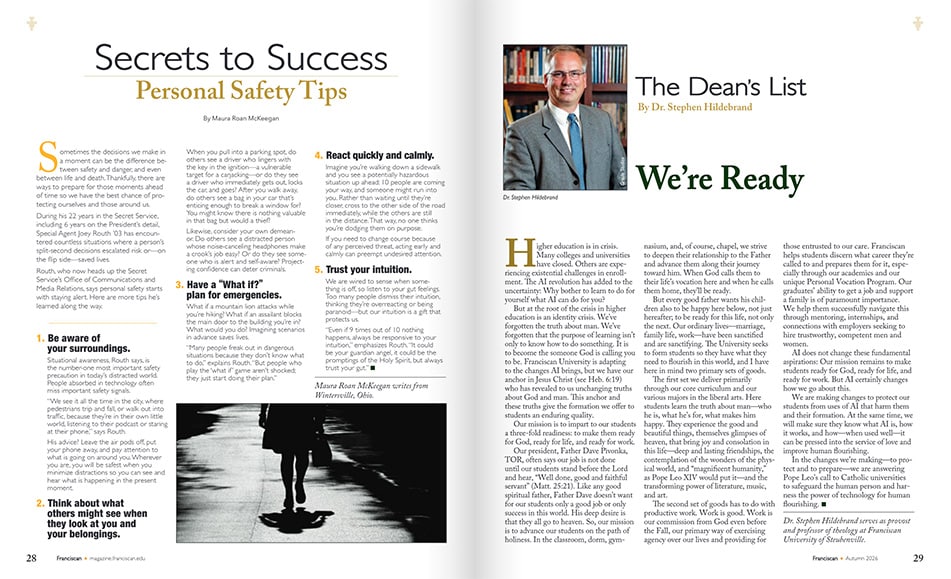

Higher education is in crisis. Many colleges and universities have closed. Others are experiencing existential challenges in enrollment. The AI revolution has added to the uncertainty: Why bother to learn to do for yourself what AI can do for you?
But at the root of the crisis in higher education is an identity crisis. We’ve forgotten the truth about man. We’ve forgotten that the purpose of learning isn’t only to know how to do something. It is to become the someone God is calling you to be. Franciscan University is adapting to the changes AI brings, but we have our anchor in Jesus Christ (see Heb. 6:19) who has revealed to us unchanging truths about God and man. This anchor and these truths give the formation we offer to students an enduring quality.
Our mission is to impart to our students a three-fold readiness: to make them ready for God, ready for life, and ready for work.
Our president, Father Dave Pivonka, TOR, often says our job is not done until our students stand before the Lord and hear, “Well done, good and faithful servant” (Matt. 25:21). Like any good spiritual father, Father Dave doesn’t want for our students only a good job or only success in this world. His deep desire is that they all go to heaven. So, our mission is to advance our students on the path of holiness. In the classroom, dorm, gymnasium, and, of course, chapel, we strive to deepen their relationship to the Father and advance them along their journey toward him. When God calls them to their life’s vocation here and when he calls them home, they’ll be ready.
But every good father wants his children also to be happy here below, not just hereafter; to be ready for this life, not only the next. Our ordinary lives—marriage, family life, work—have been sanctified and are sanctifying. The University seeks to form students so they have what they need to flourish in this world, and I have here in mind two primary sets of goods.
The first set we deliver primarily through our core curriculum and our various majors in the liberal arts. Here students learn the truth about man—who he is, what he’s for, what makes him happy. They experience the good and beautiful things, themselves glimpses of heaven, that bring joy and consolation in this life—deep and lasting friendships, the contemplation of the wonders of the physical world, and “magnificent humanity,” as Pope Leo XIV would put it—and the transforming power of literature, music, and art.
The second set of goods has to do with productive work. Work is good. Work is our commission from God even before the Fall, our primary way of exercising agency over our lives and providing for those entrusted to our care. Franciscan helps students discern what career they’re called to and prepares them for it, especially through our academics and our unique Personal Vocation Program. Our graduates’ ability to get a job and support a family is of paramount importance. We help them successfully navigate this through mentoring, internships, and connections with employers seeking to hire trustworthy, competent men and women.
AI does not change these fundamental aspirations: Our mission remains to make students ready for God, ready for life, and ready for work. But AI certainly changes how we go about this.
We are making changes to protect our students from uses of AI that harm them and their formation. At the same time, we will make sure they know what AI is, how it works, and how—when used well—it can be pressed into the service of love and improve human flourishing.
In the changes we’re making—to protect and to prepare—we are answering Pope Leo’s call to Catholic universities to safeguard the human person and harness the power of technology for human flourishing.
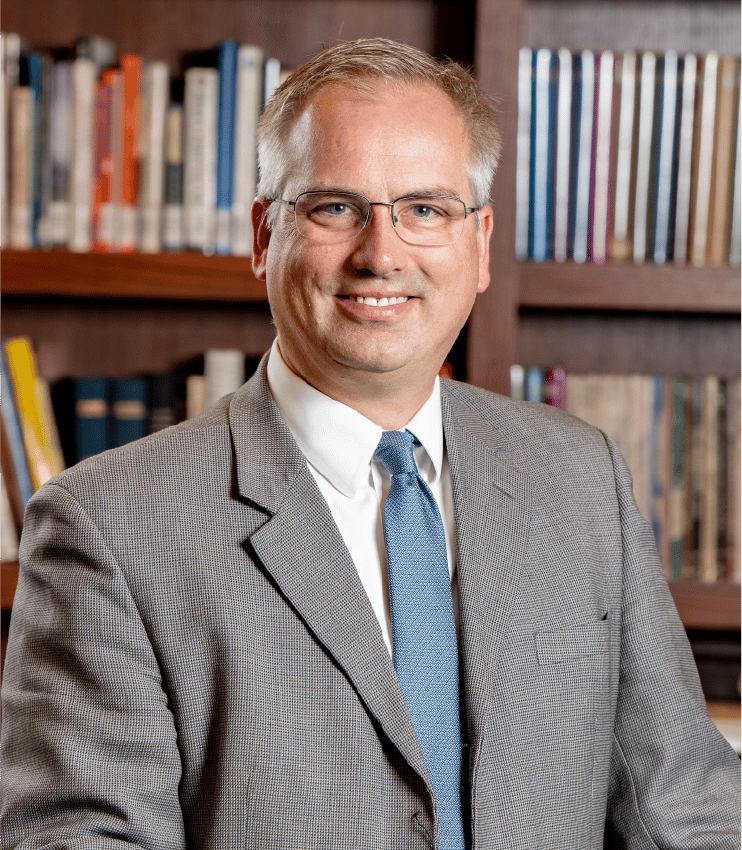
Dr. Stephen Hildebrand serves as provost and professor of theology at Franciscan University of Steubenville.