
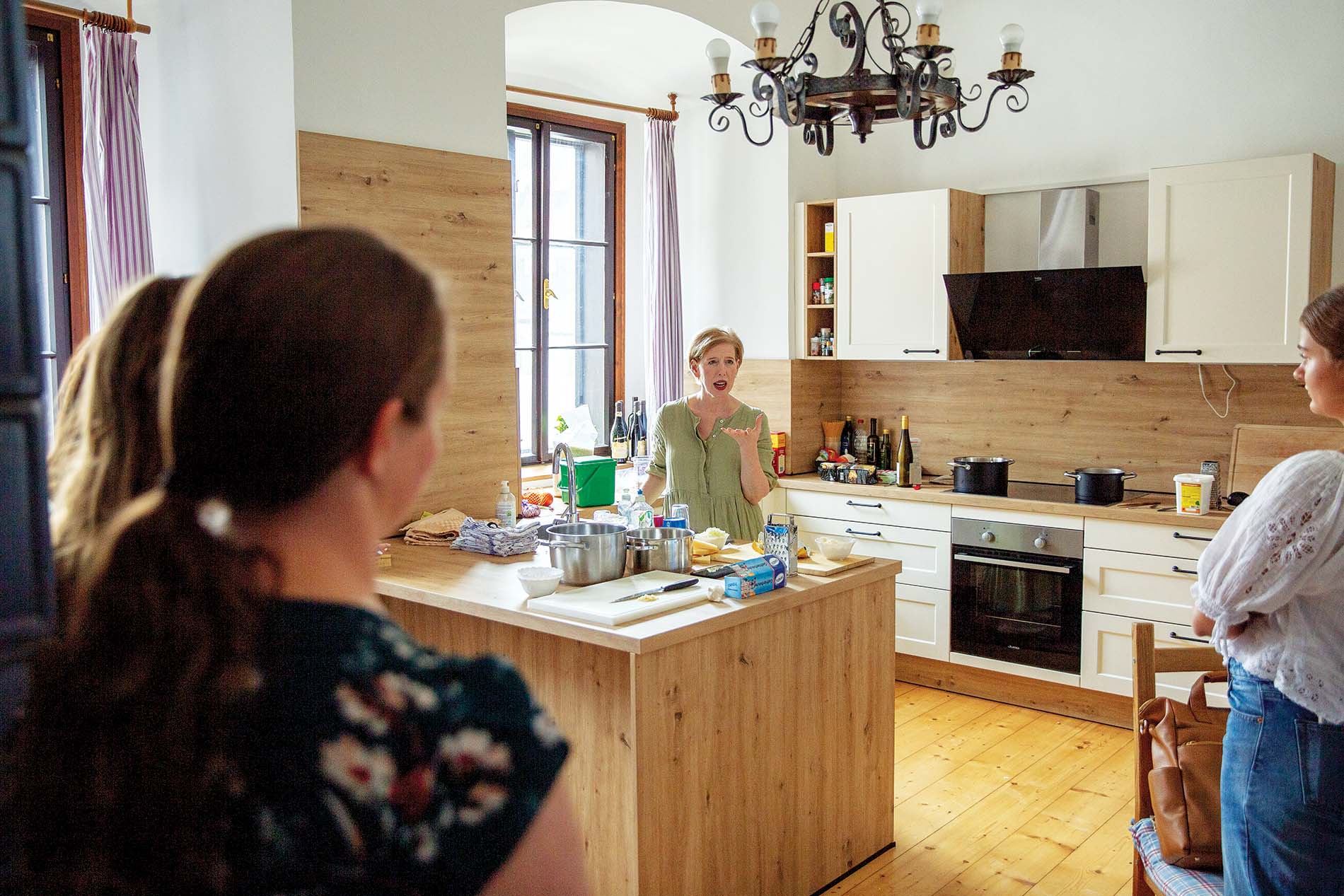
This past summer, I staged a protest against artificial intelligence. Not the kind of artificial intelligence that reads medical test results. Rather, the kind of artificial intelligence that keeps us glued to our phones, “sparing us” the arduous, messy, and often painful work of loving the people around us.
I’m sure I wasn’t the only person protesting AI this past summer. But I may have been the only one whose particular form of protest was drinking wine, cooking risotto, and throwing parties in a 14th-century monastery.
Technically, my protest was a class: Theology 388 (also known as Around the Catholic Table: A Theology of Food, Friendship, and Hospitality). But I designed the class and taught the class, so I assure you, it was a protest—the kind where you actually do something to counter the problem you’re protesting.
The idea for it—the class, not the protest—originated three years ago, when Dr. Matt Breuninger, one of the founding directors of the Austria Summer Experience, approached me about turning my books into a class for the program.
New at the time, but now in its third year, the three-week study abroad program in Gaming is open to both college-aged students and other adults, and primarily offers courses that provide intellectual and spiritual formation through hands-on activity. For example, this past summer’s classes included a philosophy course that examined virtue through the lens of breadmaking, an art course that studied Franciscan spirituality through icon painting, and a course on spiritual memoirs that explored St. Augustine’s Confessions by tasking students with writing their own spiritual autobiography. A class that imparted the theology of hospitality and community through cooking and hosting dinners seemed a perfect fit.
And was. But by the time it finally worked out for me to teach the class, the world had changed. In 2023, ChatGPT had barely celebrated its first birthday. By 2026, it was trying to replace writers, musicians, artists, therapists, friends, and spouses, accelerating the ongoing breakdown of human community and threatening to change our understanding of what it means to be human.
For years now, Americans have been growing less and less social, spending more hours with screens than friends. But this is especially true of young people, who now spend 50 percent less time with friends than we did in the 1990s. The advent of chatbots has only given teenagers and young adults more of an excuse to avoid the company of others. By August 2026, 55 percent of teenagers said they regularly sought friendship and advice from AI chatbots, while one in seven young adults said they attempted to simulate a romantic relationship with one.
Advanced artificial intelligence may offer the world some benefits, but it also offers us dangerous shelter from the challenging, humiliating, and demanding encounters that make us human, including inviting friends into our home. In that, it also offers us a different understanding of what it means to be human, promising us that a full, human life can somehow exist without the pain, sacrifice, and awkwardness that come from giving yourself to others and receiving the gift of others in return.
Which brings us back to my summer protest.
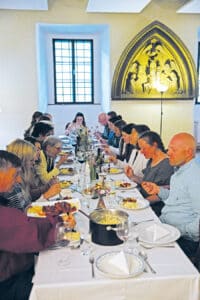
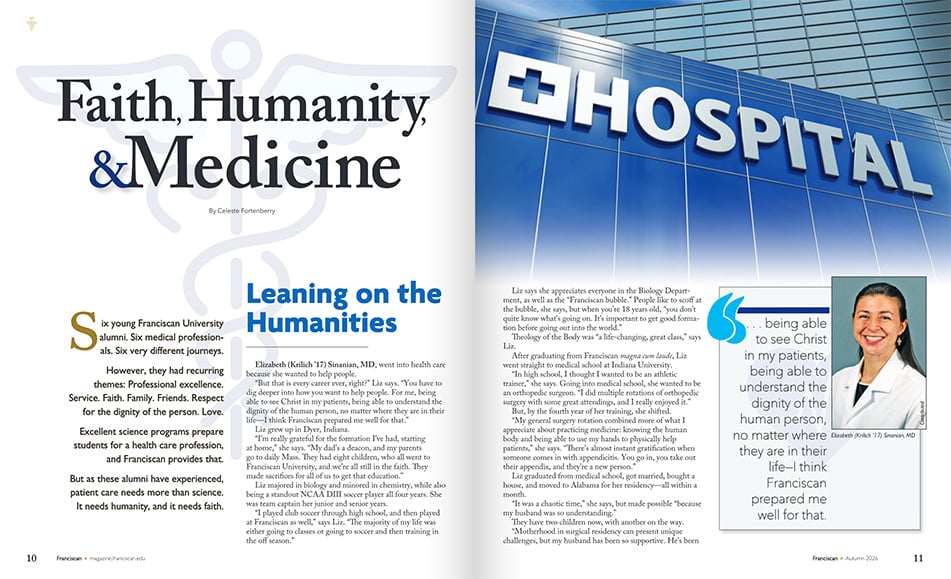
Students and friends sampling the fruits of their labors.
As I explained to the class on the first day, it had become impossible to talk about hospitality without acknowledging the looming shadow of AI. Which meant our course wouldn’t ultimately be about food or hospitality. It would be about being human. It would be about learning to see ourselves and the world rightly, so we could live rich, meaningful lives even in the age of AI. That—a human life, full of joy and purpose—was the end we sought. Food and hospitality were just the means to the end on which we would focus.
So, our protest began. Over the next three weeks, we read widely, using works of theology, philosophy, and fiction to ponder the Church’s teachings on the human person, the sacramental worldview, and the nature of community. We explored what food teaches us about God, ourselves, and the Eucharist. And we reflected upon the nature and shape of Christian hospitality.
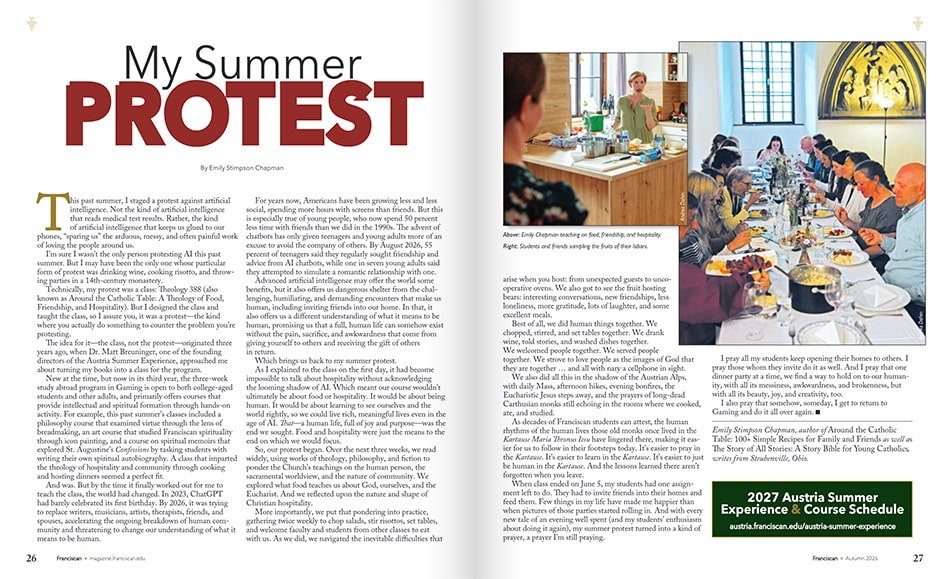
More importantly, we put that pondering into practice, gathering twice weekly to chop salads, stir risottos, set tables, and welcome faculty and students from other classes to eat with us. As we did, we navigated the inevitable difficulties that arise when you host: from unexpected guests to uncooperative ovens. We also got to see the fruit hosting bears: interesting conversations, new friendships, less loneliness, more gratitude, lots of laughter, and some excellent meals.
Best of all, we did human things together. We chopped, stirred, and set tables together. We drank wine, told stories, and washed dishes together. We welcomed people together. We served people together. We strove to love people as the images of God that they are together … and all with nary a cellphone in sight.
We also did all this in the shadow of the Austrian Alps, with daily Mass, afternoon hikes, evening bonfires, the Eucharistic Jesus steps away, and the prayers of long-dead Carthusian monks still echoing in the rooms where we cooked, ate, and studied.
As decades of Franciscan students can attest, the human rhythms of the human lives those old monks once lived in the Kartause Maria Thronus Iesu have lingered there, making it easier for us to follow in their footsteps today. It’s easier to pray in the Kartause. It’s easier to learn in the Kartause. It’s easier to just be human in the Kartause. And the lessons learned there aren’t forgotten when you leave.
When class ended on June 5, my students had one assignment left to do. They had to invite friends into their homes and feed them. Few things in my life have made me happier than when pictures of those parties started rolling in. And with every new tale of an evening well spent (and my students’ enthusiasm about doing it again), my summer protest turned into a kind of prayer, a prayer I’m still praying.
I pray all my students keep opening their homes to others. I pray those whom they invite do it as well. And I pray that one dinner party at a time, we find a way to hold on to our humanity, with all its messiness, awkwardness, and brokenness, but with all its beauty, joy, and creativity, too. I also pray that somehow, someday, I get to return to Gaming and do it all over again.
Check out the 2027 Austria Summer Experience and it’s course schedule.
Emily Stimpson Chapman, author of Around the Catholic Table: 100+ Simple Recipes for Family and Friends as well as The Story of All Stories: A Story Bible for Young Catholics, writes from Steubenville, Ohio.