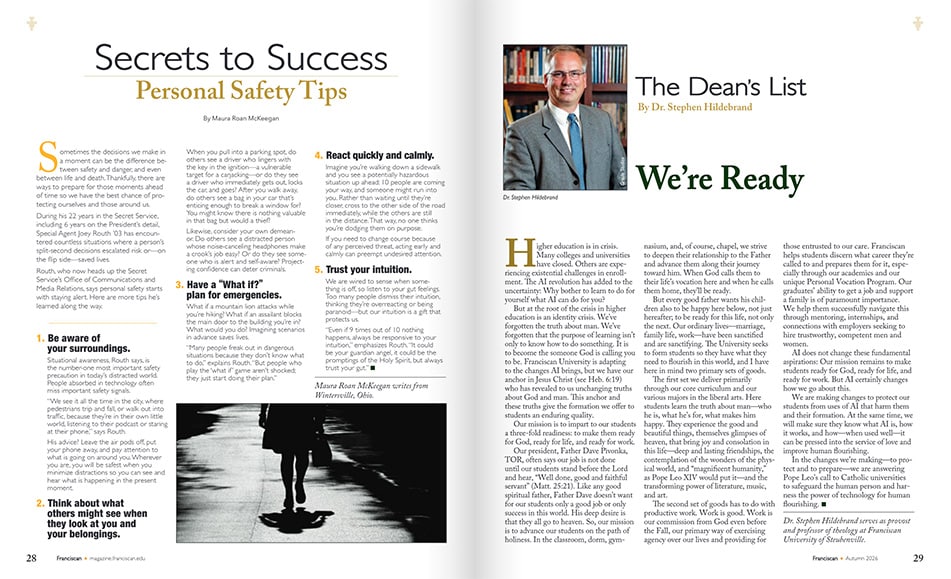

Sometimes the decisions we make in a moment can be the difference between safety and danger, and even between life and death. Thankfully, there are ways to prepare for those moments ahead of time so we have the best chance of protecting ourselves and those around us. During his 22 years in the Secret Service, including 6 years on the President’s detail, Special Agent Joey Routh ’03 has encountered countless situations where a person’s split-second decisions escalated risk or—on the flip side—saved lives. Routh, who now heads up the Secret Service’s Office of Communications and Media Relations, says personal safety starts with staying alert. Here are more tips he’s learned along the way.
1. Be aware of your surroundings.
Situational awareness, Routh says, is the number-one most important safety precaution in today’s distracted world. People absorbed in technology often miss important safety signals.
“We see it all the time in the city, where pedestrians trip and fall, or walk out into traffic, because they’re in their own little world, listening to their podcast or staring at their phone,” says Routh.
His advice? Leave the air pods off, put your phone away, and pay attention to what is going on around you. Wherever you are, you will be safest when you minimize distractions so you can see and hear what is happening in the present moment.
2. Think about what others might see when they look at you and your belongings.
When you pull into a parking spot, do others see a driver who lingers with the key in the ignition—a vulnerable target for a carjacking—or do they see a driver who immediately gets out, locks the car, and goes? After you walk away, do others see a bag in your car that’s enticing enough to break a window for? You might know there is nothing valuable in that bag but would a thief?
Likewise, consider your own demeanor. Do others see a distracted person whose noise-canceling headphones make a crook’s job easy? Or do they see someone who is alert and self-aware? Projecting confidence can deter criminals.
3. Have a “What if?” plan for emergencies.
What if a mountain lion attacks while you’re hiking? What if an assailant blocks the main door to the building you’re in? What would you do? Imagining scenarios in advance saves lives.
“Many people freak out in dangerous situations because they don’t know what to do,” explains Routh. “But people who play the ‘what if’ game aren’t shocked; they just start doing their plan.”
4. React quickly and calmly.
Imagine you’re walking down a sidewalk and you see a potentially hazardous situation up ahead: 10 people are coming your way, and someone might run into you. Rather than waiting until they’re closer, cross to the other side of the road immediately, while the others are still in the distance. That way, no one thinks you’re dodging them on purpose.
If you need to change course because of any perceived threat, acting early and calmly can preempt undesired attention.
5. Trust your intuition.
We are wired to sense when something is off, so listen to your gut feelings. Too many people dismiss their intuition, thinking they’re overreacting or being paranoid—but our intuition is a gift that protects us.
“Even if 9 times out of 10 nothing happens, always be responsive to your intuition,” emphasizes Routh. “It could be your guardian angel, it could be the promptings of the Holy Spirit, but always trust your gut.”