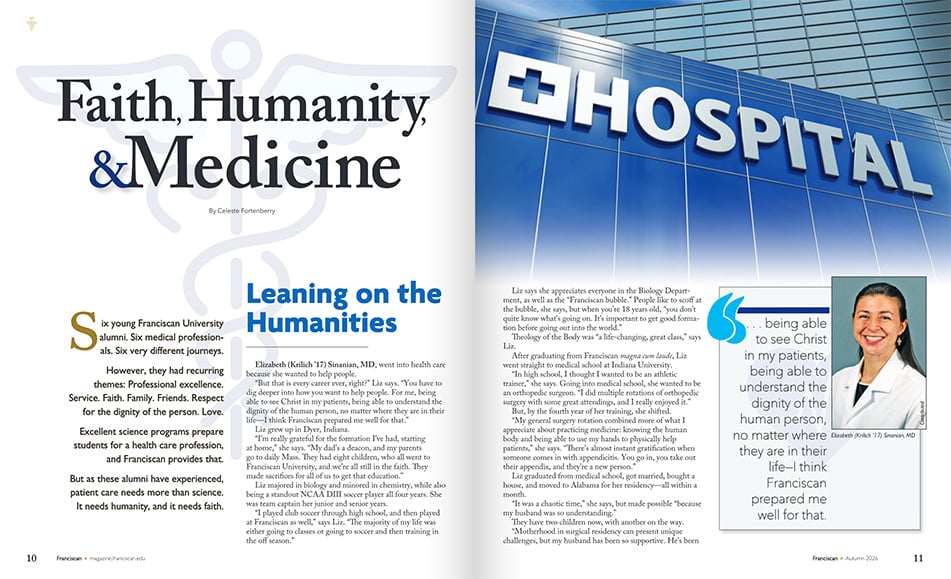
Six young Franciscan University alumni. Six medical professionals. Six very different journeys. However, they had recurring themes: Professional excellence. Service. Faith. Family. Friends. Respect for the dignity of the person. Love. Excellent science programs prepare students for a health care profession, and Franciscan provides that. But as these alumni have experienced, patient care needs more than science. It needs humanity, and it needs faith.
Franciscan Magazine
Franciscan University of Steubenville

Cover Story
Humanity, Faith, and Medicine

Humanity, Faith, and Medicine
Six alumni in the medical field share how they live their faith through the healing profession.
Fall 2026 | Celeste Fortenberry
Leaning on the Humanities
Elizabeth (Krilich ’17) Sinanian, MD, went into health care because she wanted to help people.
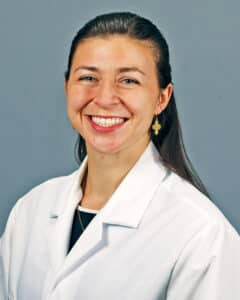
Elizabeth (Krilich ’17) Sinanian, MD
“But that is every career ever, right?” Liz says. “You have to dig deeper into how you want to help people. For me, being able to see Christ in my patients, being able to understand the dignity of the human person, no matter where they are in their life—I think Franciscan prepared me well for that.”
Liz grew up in Dyer, Indiana.
“I’m really grateful for the formation I’ve had, starting at home,” she says. “My dad’s a deacon, and my parents go to daily Mass. They had eight children, who all went to Franciscan University, and we’re all still in the faith. They made sacrifices for all of us to get that education.”
Liz majored in biology and minored in chemistry, while also being a standout NCAA DIII soccer player all four years. She was team captain her junior and senior years.
“. . . being able to see Christ in my patients, being able to understand the dignity of the human person, no matter where they are in their life—I think Franciscan prepared me well for that.”
“I played club soccer through high school, and then played at Franciscan as well,” says Liz. “The majority of my life was either going to classes or going to soccer and then training in the off season.”
Liz says she appreciates everyone in the Biology Department, as well as the “Franciscan bubble.” People like to scoff at the bubble, she says, but when you’re 18 years old, “you don’t quite know what’s going on. It’s important to get good formation before going out into the world.”
Theology of the Body was “a life-changing, great class,” says Liz.
After graduating from Franciscan magna cum laude, Liz went straight to medical school at Indiana University.
“In high school, I thought I wanted to be an athletic trainer,” she says. Going into medical school, she wanted to be an orthopedic surgeon. “I did multiple rotations of orthopedic surgery with some great attendings, and I really enjoyed it.”
But, by the fourth year of her training, she shifted.
“My general surgery rotation combined more of what I appreciate about practicing medicine: knowing the human body and being able to use my hands to physically help patients,” she says. “There’s almost instant gratification when someone comes in with appendicitis. You go in, you take out their appendix, and they’re a new person.”
Liz graduated from medical school, got married, bought a house, and moved to Alabama for her residency—all within a month.
“It was a chaotic time,” she says, but made possible “because my husband was so understanding.”
They have two children now, with another on the way.
“Motherhood in surgical residency can present unique challenges, but my husband has been so supportive. He’s been a rock through it all, a real servant of God sacrificing for our family while I worked long shifts, nights, and so on.”
Liz completed her residency at the University of South Alabama and moved back to Indiana to practice general surgery in Kokomo. The appendix, gallbladder, hernias, lumps and bumps, endoscopies, colonoscopies, whatever surgeries come from the emergency room or the clinic—these are Liz’s purview.
In practicing medicine, she leans on the humanities she studied at Franciscan.
“When you do the humanities, you’re able to use them to help your scientific mind. And when you see trauma and really terrible things, when you have to declare people dead who are younger than you, you can’t rely on your scientific mind to get you through all that. You need to have your faith. You need to have your ability to process and reflect.
“Some of my co-residents didn’t have a liberal arts background, and they had more difficulty with learning how to reflect because they’ve never had the training that philosophy and theology and all those other things give you.”
A Lifestyle of Health and Wellness
Ryan Marrow ’12, DC, CCSP, spent his first three years at Franciscan majoring in business.
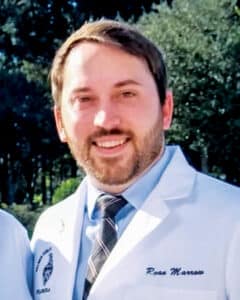
Ryan Marrow ’12, DC, CCSP
“I knew I wanted to do something where I owned my own business,” he says. “I just didn’t know what. Then, my junior year, I started working in my dad’s clinic, and I was blown away by the interactions with the patients and their stories of what my dad had done for them.”
Ryan’s dad, Dr. Robert Marrow, established St. Joseph Chiropractic in Steubenville, Ohio, after the Marrow family moved there to be part of the Franciscan University community. Ryan is the middle of seven children, all of whom studied at Franciscan.
“When you have a passion for the Lord, that just bleeds into every aspect of your life—then it bleeds over with your patients.”
Ryan decided he wanted to go into chiropractic medicine and switched to an anthropology major to get the prerequisites he needed and still graduate on time. He went to Palmer College of Chiropractic in Florida, graduated magna cum laude, and returned to Steubenville to practice with his father. Now his father is retired, and Ryan has taken over the practice.
He says it’s common for children of chiropractors to follow their parents.
“For the majority of chiropractors, the way you live seeps into the rest of your life. You believe in the physical benefits of chiropractic care, but you also value nutrition and lifestyle, clean living, and high-quality food. A lot of children who grow up in that lifestyle become chiropractors themselves.”
As a Franciscan freshman, Ryan says he wanted to grow in his faith, but he didn’t know exactly how. He credits his household, AMDG, for helping foster his faith.
“I was 18 years old, around guys who were 22, who had figured a lot of it out. I would think, ‘I want what he has.’ That’s kind of the beauty of households. They’re really good at taking young men and showing them how to grow deeper in their faith and their spirituality.”
It helped form him as a medical professional as well.
“When you have a passion for the Lord, that just bleeds into every aspect of your life—your family life, with your parents, your siblings, your spouse, your kids. And then it bleeds over with your patients,” he says. “You want to meet them where they are, provide the best care to them, treat them with dignity and respect, and try to see Christ in everyone.”
Ryan does functional nutritional medicine as a complementary therapy to chiropractic. He has a mental health therapist in his practice as part of his care for the whole person: body and mind—and spirit, if they’re open to it.
“We do a lot of fertility care through diet, detoxing, balancing hormones. Fertility is probably one of my favorites, getting that phone call from patients we’ve been working with and finding out they’re pregnant. Treating them through the pregnancy and then meeting and treating the baby—just supporting the whole family.”
Ryan also does sports medicine. He works in the training room at the University with the student-athletes.
“I think chiropractic is a really great profession that’s conducive to family life,” he says. “There aren’t enough people in alternative medicine doing preventative care. That’s really what drew me in, the prevention. Not waiting until you get sick to seek medical care but to live a lifestyle of health and wellness.”
And those three years of business school? Ryan’s put them to good use.
“Usually doctors who work independently and own their own businesses are very well trained to be doctors but not on how to run a business. Franciscan absolutely prepared me with a well-rounded education: business and science, and writing, critical thinking, deductive reasoning. A lot of friends who went to medical school have told me the same thing: Franciscan prepared them very well.”
An Old-Time Family Doctor
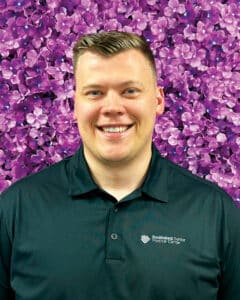
As a Franciscan biology major with a minor in theology, Joseph Rall ’18, DO, went on medical mission trips to Ecuador.
Joseph Rall ’18, DO
“Franciscan students, a team of doctors and nurses, and several priests go into the jungles,” says Joseph. “They’re pretty remote areas. Basically, you drive until you can’t drive any more, and then you hike for almost a whole day to get to these villages. We brought the sacraments and medical care. These people weren’t seeing a doctor for a year or two at a time. The same with the sacraments.”
On these missions, Joseph saw medicine at the service of the poor. And he caught the spark for his current work.
“The doctors who went with us were primary care doctors, mostly. You could put them in a foreign country in the middle of the jungle, and they knew enough to be able to help people. Seeing them practice medicine in that setting solidified the idea that I wanted to go into primary care.”
Joseph practices at ChenMed in Cleveland, a value-based care organization serving the neediest patients.
“Fee-for-service is the mainstream way of paying for health care,” says Joseph. “In value-based care, instead of being paid for services, we’re paid for outcomes. We have what’s called full upside and full downside risk. It’s up to us to take good care of the patient because we are all in on the financial risk. We’re incentivized to keep them healthy.”
“A sick body on its face isn’t a beautiful thing, but we know it’s beautiful because it’s Christ.”
Joseph says they see their patients much more often than most primary care doctors do.
“I see all my patients every month, and some of them I see twice a month or even more often, depending on their needs.”
His practice serves the neediest urban patients.
“My average patient is very sick, with five or six medical co-morbidities,” says Joseph. “Oftentimes, they have addiction issues or psychological issues, or homelessness. They’re people with a lot of needs, and the system isn’t really set up to watch out for them.”
A key to better outcomes, he says, is trust.
“If I really know them, and I build trust with them, they’re going to come to me before they have a problem. We can detect pneumonia or a UTI before they need to be hospitalized. In Catholic-speak, we have solidarity. My good and the patient’s good are tied up together.”
Joseph grew up in Ohio, one of four brothers, all Franciscan alumni. He attended medical school at Ohio University and did a family medicine residency in Cleveland. That’s when he met his wife, a labor and delivery nurse (now staying home with the children). They have three daughters and a fourth on the way.
“Being like an old-time family doctor was really attractive to me,” says Joseph. “I wanted to take care of the whole person, so primary care made a lot of sense. The primary care doctor has to be concerned not just about physical health, but emotional, psychological, and even spiritual health. Health is a person who’s thriving.”
Joseph is inspired in his work by St. Francis’ encounter with the leper. Like Francis, initially he can be disgusted, but through grace, he sees the beauty of the leper.
“It’s challenging and ugly and gross at times. Not the people. But the world is a hard place, and I see it up close all the time. A sick body on its face isn’t a beautiful thing, but we know it’s beautiful because it’s Christ.
“It’s teaching me how to love.”
Improving Maternal-Fetal Outcomes
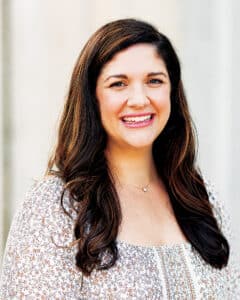
Katherine (Hoffer ’10) Stanek, CNM, didn’t plan to be a midwife.
Katherine (Hoffer ’10) Stanek, CNM
“I had always wanted to be a nurse,” Katie says, “and I knew Franciscan had an excellent Nursing Program. So, I found my way to Steubenville with a few of my friends, and I loved it. I had such a great four years. A lot of it was the strong Catholic environment but also Franciscan’s strong academics. I had great clinical opportunities and faith-life balance. I was very well prepared when I graduated.”
Katie was committed to working at a hospital that had given her a scholarship.
“I started working as a labor and delivery nurse. I fell in love with it.”
Later, as a travel nurse, Katie worked at a “great little community hospital” in Florida.
“They had two amazing midwives. I worked with them, and I thought, ‘Wow, this is a very different way of giving birth.’ I loved how they connected with their patients and took care of women. I felt this little tug that this was what I was supposed to do,” she says. “My mom thought I was crazy at first, and she worried I wouldn’t find a job—but I couldn’t shake the feeling. I went back to school and became a midwife. I have never regretted it.”
“My Catholic faith is what keeps me grounded in a sometimes very tumultuous health care environment.”
Katie worked as a midwife in Virginia (where she’s from); then, during COVID, she moved to Washington state, as they were more midwifery friendly (which is where she met her husband).
Katie believes midwifery is becoming more popular because it helps improve maternalfetal outcomes.
“We spend more than any other country on maternity care, and we have some of the worst outcomes.Midwives respect physiologic birth, making birth less medical. We obviously intervene as appropriate or refer.
“I mostly do obstetric care for military families. There are 12 of us in our group, so we take care of our patients as a team. We do prenatal care. One of us will be there for the birth. We support the mother if there’s an emergency. We don’t do C-sections, but we’ll be there for them. We also work as faculty for a military OB/GYN residency program, training them in physiologic pregnancy and birth.”
Katie says the Nursing Program at Franciscan was science-heavy, of course, but that the curriculum was designed to foster empathy, morality, and the human connection. “There are a lot of aspects to caring for people and to understanding the things that will guide your conscience and your work. All that plays into being a well-rounded individual and having a greater understanding of human connection.”
Katie also credits Franciscan for helping her develop a more personal faith.
“I’ve been Catholic my whole life, but the University gave me a faith in which I could develop as a young adult and then go out into the world. My Catholic faith is what keeps me grounded in a sometimes very tumultuous health care environment. I can bring my knowledge and my skills and my judgment to the bedside, but there are a lot of things you can’t control. So, those are the things that I rely on my faith for and credit the foundation I got at Franciscan.”
Working in health care is challenging, she says, particularly for those who care deeply for others.
“You’re trying to be there with people as they go through some of the greatest highs of their lives and also profound moments of grief. You’re on this roller coaster. It’s so vulnerable. Thrown in the middle of all of this, it’s important to be grounded in something that’s greater than yourself.
“My role is to care for women and their families. My faith reminds me the person has dignity. I keep that at the center of how I practice, with the mother, the baby, and the entire family unit.”
Katie says she tries to practice health care “in a very Franciscan way: Preach the Gospel always, and when necessary, use words.
Faith Keeps You Going
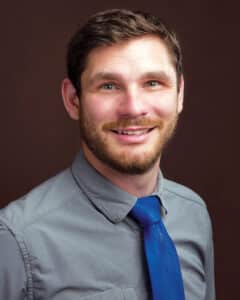
Peter McCullough ’18, MD, FMOB, grew up on an apple orchard in Washington state, one of seven children; then he moved to Wyoming to attend Wyoming Catholic College in Lander. He was in their first graduating class and earned a
Peter McCullough ’18, MD, FMOB
liberal arts degree. He worked in search and rescue in Wyoming, then took his first “medical” job, as an aide in a traumatic brain injury unit. He was recruited to join an investigative team that looks into abuses against people with disabilities. He says it opened his eyes to the dark side of medicine and the world in general, but he also met some great doctors and thought medicine might be a good career.
However, he needed undergraduate science credits to get into medical school.
“The only place that took Wyoming Catholic College’s credits at that time was Franciscan. So, I was going to go and plug in as many credits as I could and then fill in the rest with science so I could get my pre-reqs for medical school.”
But he didn’t go to Franciscan. He went scuba diving. A bad accident “put life on the back burner,” he says. “I couldn’t walk. I couldn’t do anything. I had dizziness and vertigo. I couldn’t drive.”
“Faith’s pretty much the only thing that gets you through some of the things you see in medicine.”
After months of rehab, “I was getting stir crazy,” he says, but, once again, he did not go to Franciscan. He “got in his Dodge Neon and drove to North Dakota and picked up a job on a workover rig in the oilfield. It was intense work with long hours.”
But Peter says it was also good.
“Most of the guys couldn’t read and write, and I could, so I got the jobs that involved measuring, taking notes, and math that the boss would typically do. I worked the floor, making and breaking pipe, throwing chain, and it’s extremely dangerous.”
By the end of three years, Peter was senior lead field engineer for the northern Rockies. At that point, the company wanted to send him to work in Houston.
“It would have meant losing my crews, my guys that I had spent years building a team with. So I said, ‘You know, there was a while ago where I was thinking about becoming a doctor.’”
He quit, loaded up his Jeep, and (finally) drove to Steubenville, Ohio.
“I wasn’t really that interested in going to Franciscan,” Peter admits. “It ended up being one of the best decisions I’ve made.”
The professors helped him cram a biology major and chemistry minor into four semesters. He spent most of his days studying, researching, and running to take exams, but he also found time for friendships.
“I met a lot of really wonderful people who gave me community. I was very intimidated by just moving there. I didn’t know anybody or anything,” he says. “A lot of families just took me in. Many of them ended up in my wedding and regularly visit me now, and I regularly go to Ohio to see them.”
When he graduated, he took a gap year, sort of, spending his time teaching chemistry and physics at Franciscan. Then, he went to the University of Washington School of Medicine through the Wyoming TRUST pathway of the WWAMI program. He did his residency in Wichita, Kansas, and is back in Wyoming with his wife, ready to practice primary care at a brand-new community hospital, RiverPeak Health.
“In primary care these days,” says Peter, “your patients are entrusting to you some of their biggest problems. I have patients who are schizophrenic, bipolar, have severe depression. They’ve been abused or raped or beaten. They’ve had horrific childhoods. So, you have to wear many hats, and one of them is, how are you coping? Have you considered prayer?”
Peter notes that praying over people wasn’t really his gig.
“I’m not very outward or charismatic.” But he says, “Turns out when somebody is dying, this is a really great thing to do. To put your hands on somebody and pray for them when they’re taking their last breaths, and they don’t want to die. Or people asking to be baptized moments before their death. It’s very beautiful. It’s very intense.
“Faith’s pretty much the only thing that gets you through some of the things you see in medicine.”
Peter says it helps him with the intense, dramatic moments, and the everyday things that grind him down, like 22 days straight of 14-hour shifts or late-night emergency C-sections.
“If I can get the baby out in three or four Our Fathers, then it’s a good night.”
Or working in pediatric intensive care, watching kids fade away slowly.
“Faith is the only thing that’ll keep you going when you’ve lost six kids in three weeks, and there’s nothing you can do about it,” he says. “You don’t have the luxury of being average at your job. It’s unbelievably exhausting. And so you pray. You lean into prayer.”
Take Every Day as Gift
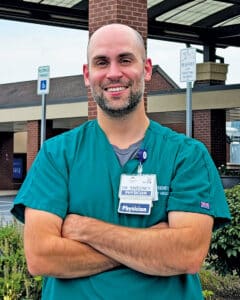
Kevin Sweeney ’12, DO, grew up in Altoona, Pennsylvania. His father is a family physician; his mother is a retired nurse. Kevin wasn’t sure he’d follow his parents into medicine. But he knew he liked the sciences, so he majored in biology and
Kevin Sweeney ’12, DO
minored in chemistry. He’d heard really good things about Franciscan University’s Biology Department and the success they had in getting graduates into medical school.
March of his junior year, his youngest sister became very sick and passed away in April.
“She was 11 at the time,” says Kevin. “I don’t think I had prayed that intensely in my entire life. Now, I try to take every day as a gift. You can’t take any day for granted because she was gone so quickly.”
The experience opened his eyes to the world of medicine beyond his father’s practice. But he still wasn’t sure it was the right path, so after graduating, he moved to Washington, D.C., to work as an emergency medicine technician at George Washington Hospital.
“Everyone has dignity and deserves to hold that dignity, even in their most dire and most embarrassing and most uncomfortable needs.”
“I jumped into the deep end with the world of the ER,” says Kevin. “I was thinking I was going to be an orthopedic surgeon, and then I was like, why? I have such an amazing time in the ER.”
Kevin went to Lake Erie College of Osteopathic Medicine in Pennsylvania and did his residency in emergency medicine in York, Pennsylvania. He’s currently practicing emergency medicine at Wellspan Ephrata Community Hospital.
“I don’t go into a shift without thinking about how to treat everyone with compassion and with dignity,” “the way I was taught through the actions and inspiration of my amazing parents, incredible wife, and Jesus, the Divine Physician.”
He wears a St. Luke medal and keeps a rosary from his wife—a gift from when they were engaged—in his scrubs.
“I hold onto these as I go from shift to shift.”
Each day brings a unique struggle, he says.
“I try to treat each patient the way I would want to be treated. Everyone has dignity and deserves to hold that dignity, even in their most dire and most embarrassing and most uncomfortable needs.”
In a 10-hour shift, Kevin will see roughly 25 patients.
“The patient issues vary from lacerations, where you’re throwing in a couple of stitches, to cardiac resuscitation, where you’re doing CPR to save the patient’s life,” he says. “There’s a huge mental load. Each shift is like taking a 10-hour exam.”
Kevin says he couldn’t practice medicine without his wife, his two children, his family, and of course, his faith.
Pittsburgh sports help, too: “I’m a diehard Steelers and Pirates fan.”
Even with the stress of emergency medicine, Kevin keeps the focus on the patient.
“It’s about who is in front of me,” he says, “and to take the best care I can. I’ve been on the other side, with my sister. I’ve been through the sorrow and uncertainty. I really owe a lot to my Catholic upbringing, what Franciscan showed me, and the brothers I have through Lion of Judah Household.”