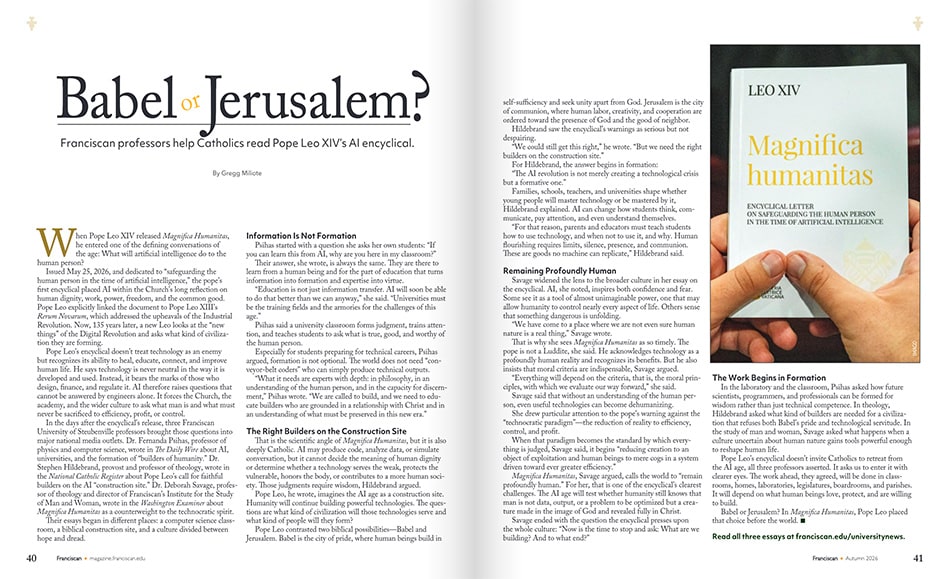

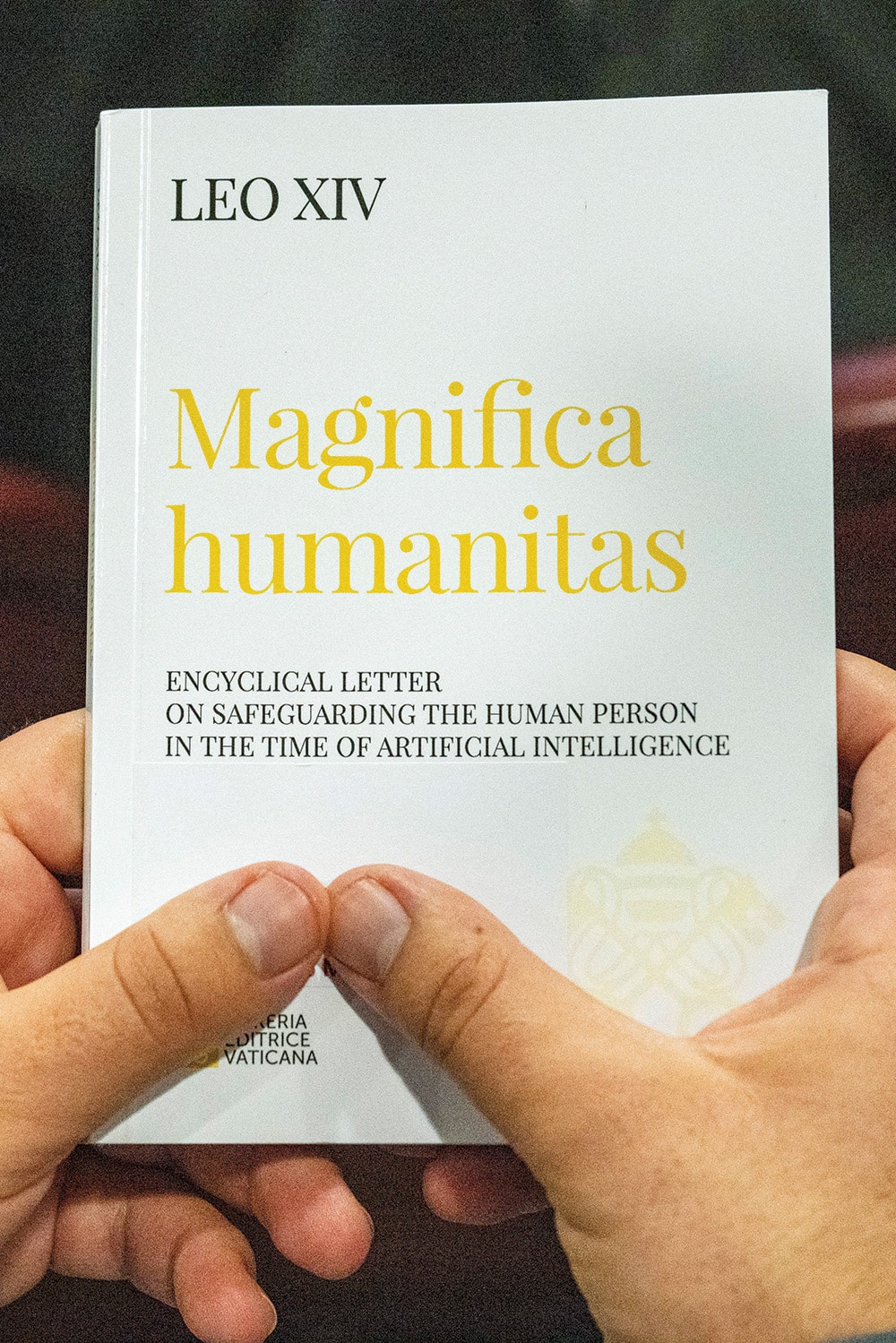
When Pope Leo XIV released Magnifica Humanitas, he entered one of the defining conversations of the age: What will artificial intelligence do to the human person?
Issued May 25, 2026, and dedicated to “safeguarding the human person in the time of artificial intelligence,” the pope’s first encyclical placed AI within the Church’s long reflection on human dignity, work, power, freedom, and the common good. Pope Leo explicitly linked the document to Pope Leo XIII’s Rerum Novarum, which addressed the upheavals of the Industrial Revolution. Now, 135 years later, a new Leo looks at the “new things” of the Digital Revolution and asks what kind of civilization they are forming.
Pope Leo’s encyclical doesn’t treat technology as an enemy but recognizes its ability to heal, educate, connect, and improve human life. He says technology is never neutral in the way it is developed and used. Instead, it bears the marks of those who design, finance, and regulate it. AI therefore raises questions that cannot be answered by engineers alone. It forces the Church, the academy, and the wider culture to ask what man is and what must never be sacrificed to efficiency, profit, or control.
In the days after the encyclical’s release, three Franciscan University of Steubenville professors brought those questions into major national media outlets. Dr. Fernanda Psihas, professor of physics and computer science, wrote in The Daily Wire about AI, universities, and the formation of “builders of humanity.” Dr. Stephen Hildebrand, provost and professor of theology, wrote in the National Catholic Register about Pope Leo’s call for faithful builders on the AI “construction site.” Dr. Deborah Savage, professor of theology and director of Franciscan’s Institute for the Study of Man and Woman, wrote in the Washington Examiner about Magnifica Humanitas as a counterweight to the technocratic spirit.
Their essays began in different places: a computer science classroom, a biblical construction site, and a culture divided between hope and dread.
Information Is Not Formation
Psihas started with a question she asks her own students: “If you can learn this from AI, why are you here in my classroom?”
Their answer, she wrote, is always the same. They are there to learn from a human being and for the part of education that turns information into formation and expertise into virtue.
“Education is not just information transfer. AI will soon be able to do that better than we can anyway,” she said. “Universities must be the training fields and the armories for the challenges of this age.”
Psihas said a university classroom forms judgment, trains attention, and teaches students to ask what is true, good, and worthy of the human person.
Especially for students preparing for technical careers, Psihas argued, formation is not optional. The world does not need “conveyor-belt coders” who can simply produce technical outputs.
“What it needs are experts with depth: in philosophy, in an understanding of the human person, and in the capacity for discernment,” Psihas wrote. “We are called to build, and we need to educate builders who are grounded in a relationship with Christ and in an understanding of what must be preserved in this new era.”
The Right Builders on the Construction Site
That is the scientific angle of Magnifica Humanitas, but it is also deeply Catholic. AI may produce code, analyze data, or simulate conversation, but it cannot decide the meaning of human dignity or determine whether a technology serves the weak, protects the vulnerable, honors the body, or contributes to a more human society. Those judgments require wisdom, Hildebrand argued.
Pope Leo, he wrote, imagines the AI age as a construction site. Humanity will continue building powerful technologies. The questions are what kind of civilization will those technologies serve and what kind of people will they form?
Pope Leo contrasted two biblical possibilities—Babel and Jerusalem. Babel is the city of pride, where human beings build in self-sufficiency and seek unity apart from God. Jerusalem is the city of communion, where human labor, creativity, and cooperation are ordered toward the presence of God and the good of neighbor.
Hildebrand saw the encyclical’s warnings as serious but not despairing.
“We could still get this right,” he wrote. “But we need the right builders on the construction site.”
For Hildebrand, the answer begins in formation:
“The AI revolution is not merely creating a technological crisis but a formative one.”
Families, schools, teachers, and universities shape whether young people will master technology or be mastered by it, Hildebrand explained. AI can change how students think, communicate, pay attention, and even understand themselves.
“For that reason, parents and educators must teach students how to use technology, and when not to use it, and why. Human flourishing requires limits, silence, presence, and communion. These are goods no machine can replicate,” Hildebrand said.
Remaining Profoundly Human
Savage widened the lens to the broader culture in her essay on the encyclical. AI, she noted, inspires both confidence and fear. Some see it as a tool of almost unimaginable power, one that may allow humanity to control nearly every aspect of life. Others sense that something dangerous is unfolding.
“We have come to a place where we are not even sure human nature is a real thing,” Savage wrote.
That is why she sees Magnifica Humanitas as so timely. The pope is not a Luddite, she said. He acknowledges technology as a profoundly human reality and recognizes its benefits. But he also insists that moral criteria are indispensable, Savage argued.
“Everything will depend on the criteria, that is, the moral principles, with which we evaluate our way forward,” she said.
Savage said that without an understanding of the human person, even useful technologies can become dehumanizing.
She drew particular attention to the pope’s warning against the “technocratic paradigm”—the reduction of reality to efficiency, control, and profit.
When that paradigm becomes the standard by which everything is judged, Savage said, it begins “reducing creation to an object of exploitation and human beings to mere cogs in a system driven toward ever greater efficiency.”
Magnifica Humanitas, Savage argued, calls the world to “remain profoundly human.” For her, that is one of the encyclical’s clearest challenges. The AI age will test whether humanity still knows that man is not data, output, or a problem to be optimized but a creature made in the image of God and revealed fully in Christ.
Savage ended with the question the encyclical presses upon the whole culture: “Now is the time to stop and ask: What are we building? And to what end?”
The Work Begins in Formation
In the laboratory and the classroom, Psihas asked how future scientists, programmers, and professionals can be formed for wisdom rather than just technical competence. In theology, Hildebrand asked what kind of builders are needed for a civilization that refuses both Babel’s pride and technological servitude. In the study of man and woman, Savage asked what happens when a culture uncertain about human nature gains tools powerful enough to reshape human life.
Pope Leo’s encyclical doesn’t invite Catholics to retreat from the AI age, all three professors asserted. It asks us to enter it with clearer eyes. The work ahead, they agreed, will be done in classrooms, homes, laboratories, legislatures, boardrooms, and parishes. It will depend on what human beings love, protect, and are willing to build.
Babel or Jerusalem? In Magnifica Humanitas, Pope Leo placed that choice before the world.