

Pope Leo XIV states in his encyclical Magnifica Humanitas that “moral judgment cannot be reduced to calculation, for it involves conscience, personal responsibility, and the recognition of the other as a person” (No. 198).
For Franciscan University students in the Baron Crow Project, the pope’s words ring all the truer.
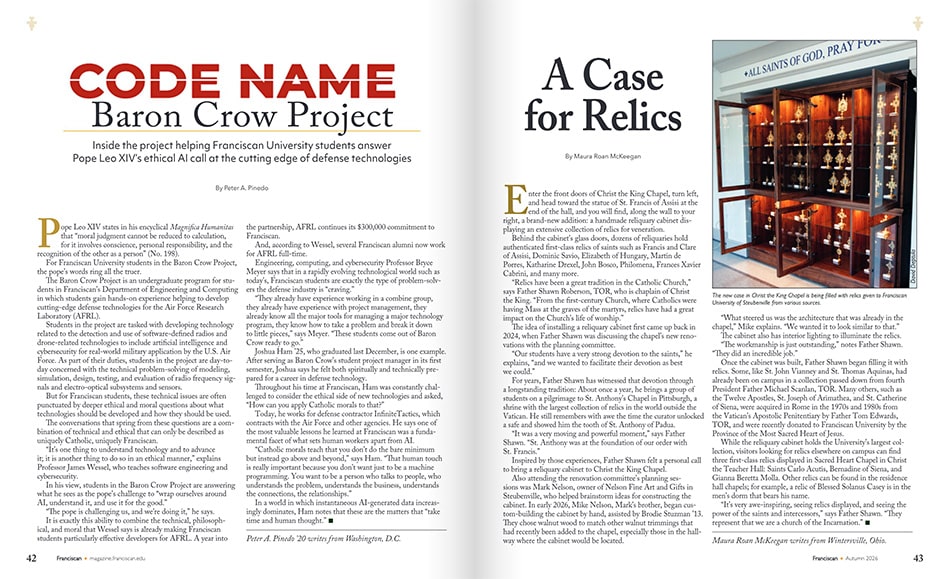
The Baron Crow Project is an undergraduate program for students in Franciscan’s Department of Engineering and Computing in which students gain hands-on experience helping to develop cutting-edge defense technologies for the Air Force Research Laboratory (AFRL).
Students in the project are tasked with developing technology related to the detection and use of software-defined radios and drone-related technologies to include artificial intelligence and cybersecurity for real-world military application by the U.S. Air Force. As part of their duties, students in the project are day-today concerned with the technical problem-solving of modeling, simulation, design, testing, and evaluation of radio frequency signals and electro-optical subsystems and sensors.
But for Franciscan students, these technical issues are often punctuated by deeper ethical and moral questions about what technologies should be developed and how they should be used.
The conversations that spring from these questions are a combination of technical and ethical that can only be described as uniquely Catholic, uniquely Franciscan.
“It’s one thing to understand technology and to advance it; it is another thing to do so in an ethical manner,” explains Professor James Wessel, who teaches software engineering and cybersecurity.
In his view, students in the Baron Crow Project are answering what he sees as the pope’s challenge to “wrap ourselves around AI, understand it, and use it for the good.”
“The pope is challenging us, and we’re doing it,” he says.
It is exactly this ability to combine the technical, philosophical, and moral that Wessel says is already making Franciscan students particularly effective developers for AFRL. A year into the partnership, AFRL continues its $300,000 commitment to Franciscan.
And, according to Wessel, several Franciscan alumni now work for AFRL full-time.
Engineering, computing, and cybersecurity Professor Bryce Meyer says that in a rapidly evolving technological world such as today’s, Franciscan students are exactly the type of problem-solvers the defense industry is “craving.”
“They already have experience working in a combine group, they already have experience with project management, they already know all the major tools for managing a major technology program, they know how to take a problem and break it down to little pieces,” says Meyer. “These students come out of Baron Crow ready to go.”
Joshua Ham ’25, who graduated last December, is one example. After serving as Baron Crow’s student project manager in its first semester, Joshua says he felt both spiritually and technically prepared for a career in defense technology.
Throughout his time at Franciscan, Ham was constantly challenged to consider the ethical side of new technologies and asked, “How can you apply Catholic morals to that?”
Today, he works for defense contractor InfiniteTactics, which contracts with the Air Force and other agencies. He says one of the most valuable lessons he learned at Franciscan was a fundamental facet of what sets human workers apart from AI.
“Catholic morals teach that you don’t do the bare minimum but instead go above and beyond,” says Ham. “That human touch is really important because you don’t want just to be a machine programming. You want to be a person who talks to people, who understands the problem, understands the business, understands the connections, the relationships.”
In a world in which instantaneous AI-generated data increasingly dominates, Ham notes that these are the matters that “take time and human thought.”