“The Lord Gave Me Brothers”
Last year, I had the opportunity to teach for a semester in Gaming, Austria. On our pilgrimage to Assisi, Father Nathan Malavolti, TOR, pointed out something I hadn’t noticed in previous visits. In the Basilica of St. Francis, the body of the great saint isn’t buried alone. Rather, three of his dear brothers are buried in close proximity to him in the crypt. Francis carried out his mission of rebuilding the Church in community with his brothers—and even in death, he is buried in their company. And, on that great day when their bodies will rise from the grave to be reunited with their souls, even this will be experienced amidst friends. In our fractured society, it was a good reminder to me that holiness isn’t achieved in isolation. We need one another.
—Dr. James Pauley ’95 MA ’97
Professor of Theology and Catechetics
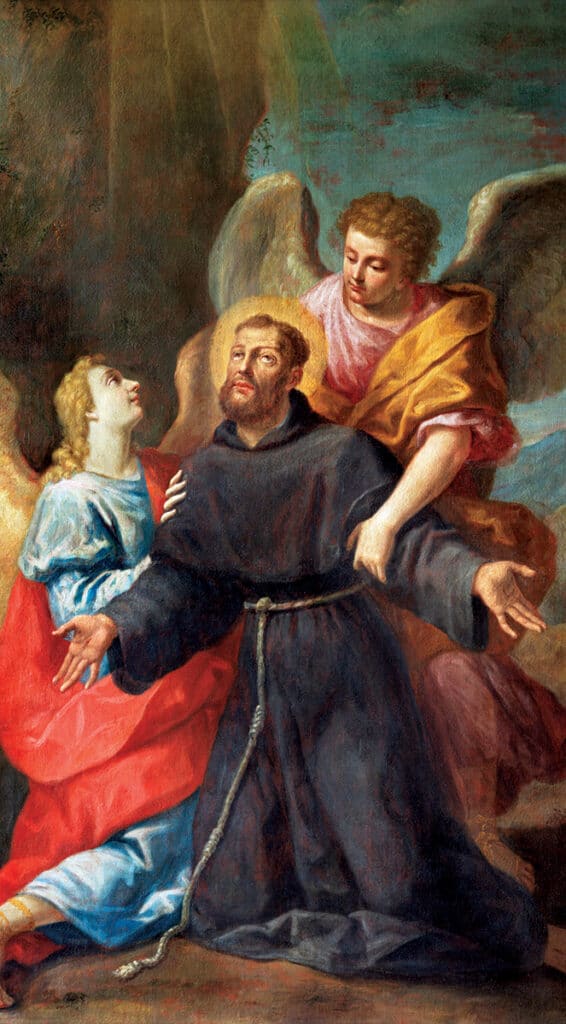
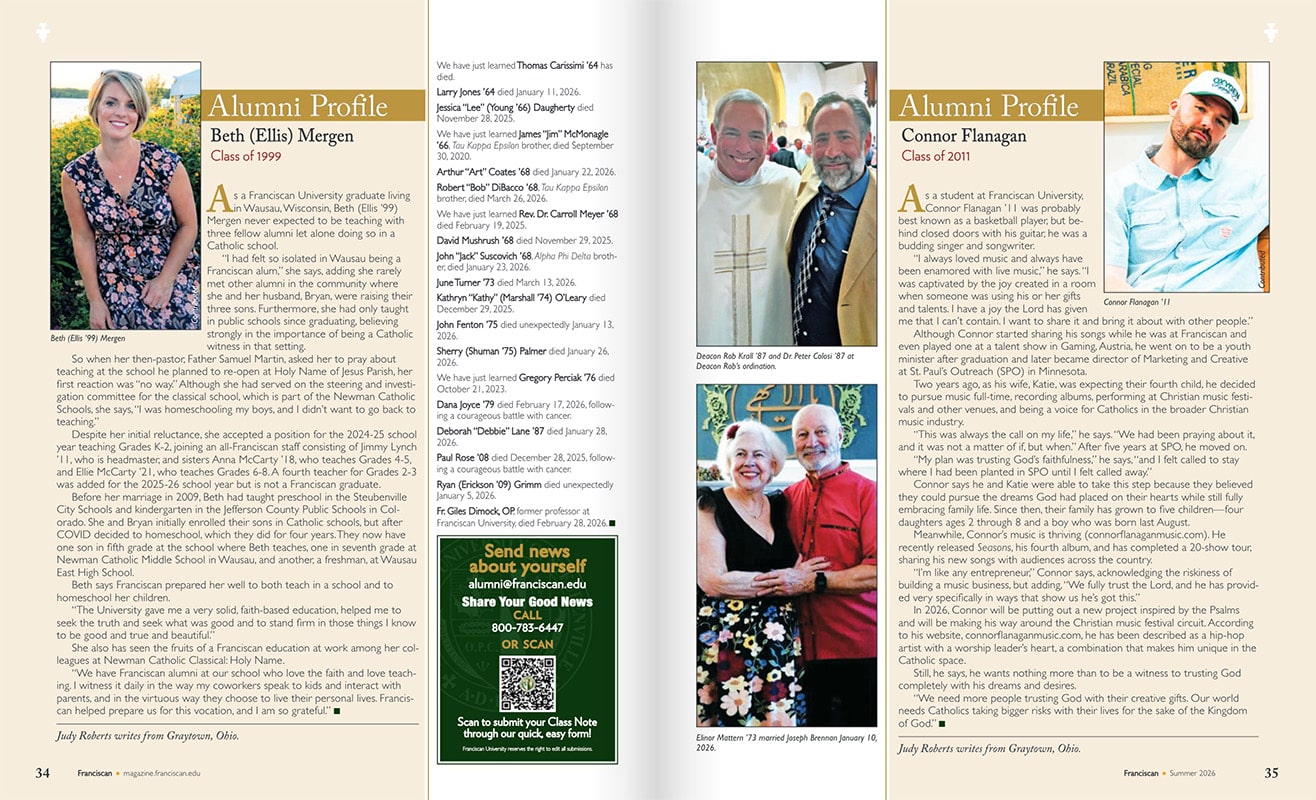
The Stigmatisation of St. Francis of Assisi in the Church of St. Francis in Ferrara by G. Mazonni (1673 – 1767).
The Thread of St. Francis: Providence and Healing
Sometimes when working here, I will ponder St. Francis and the things he stood for. I would say St. Francis’ charity and healing are what strike me the most. Charity is a way for providential acts of God to take place and therein, healing.
But St. Francis of Assisi is more than a historical figure to me. He reminds me of a spiritual thread woven through my family’s history and my professional identity. His legacy manifests in both the “holy coincidences” of my past and the intentionality of my counseling practice today.
My family’s connection to the saint began with my grandmother. After escaping the wars in Bosnia-Herzegovina, she found herself in Canada—widowed, pregnant with my father, and unable to speak English or French. In her isolation, a Croatian Catholic community dedicated to St. Francis reached out, providing her with a French-speaking host family and the support she needed to survive. In gratitude for this providential help, my grandmother gave my father the middle name Francis. My father continued this tradition, naming my brother Francis and my younger sister Frances-Clare. This spiritual lineage took a literal turn when I was 10 years old; my father, Dr. Stephen Miletic, was headhunted by the then-dean of Faculty to lead the Theology Department at Franciscan University.
I eventually followed in those footsteps, completing both my undergraduate and graduate degrees in counseling here and now working in the University’s Counseling Services. St. Francis’ spirit of radical empathy is something I strive for in my work as a counselor, as I seek to see the inherent dignity in every soul, just as he did with the marginalized of his time.
For me, St. Francis is a constant reminder of our interconnectedness. Whether through the healing words I offer in a clinical session or the beautiful timing of my family’s history, I am reminded that we are all part of a larger Franciscan story—one defined by peace, humility, and enduring love.
—Rose Miletic ’12 MA ’17
Clinical Supervisor/On-Call Counselor Baron Wellness Center
Traveling With St. Francis
As the manager of Outreach for the Steubenville Conference Office, the spirit of St. Francis of Assisi inspires and accompanies me every day on my travels around the country. My role is to invite, support, and encourage youth leaders to bring teens tour summer conferences. When I meet with them in their dioceses, I often explain how our mission reflects what St. Francis heard while praying before the San Damiano Cross 800 years ago: “Rebuild my Church.” I share that at Franciscan University, we take this call to heart. We not only form joyful disciples, but we also send them out. I tell them we want the young people in their parish or school to come and experience the grace and power of the Holy Spirit alive and active at our summer Youth Conferences.
Reflecting on how St. Francis responded to his call gives me courage and confidence as I travel and continually offer this heartfelt invitation to those in youth ministry. St. Francis also encourages me to travel without complaining! I often recall how St. Francis said, “The world is my cloister.” He traveled way farther than I ever have, and he didn’t have the comforts of modern travel—comfy Hokas, a cell phone with GPS, a rental car, nearby restaurants, or a credit card.
I am grateful for his example of humility, love for Jesus, and openness to suffer for the Lord. I love his missionary heart, poverty of spirit, unwavering determination to “rebuild” the Church, and tenacity for proclaiming the Kingdom of God. St. Francis of Assisi, pray for us!
—Laura Werner
Manager of Outreach and Stewardship Steubenville Conferences
The Journey of Wisdom
Franciscan University of Steubenville: Our very name indicates we are Franciscan, but what makes a Franciscan education “Franciscan”?
A Franciscan education doesn’t begin with St. Francis or St. Clare of Assisi. It begins with the One they loved and modeled their lives after, Jesus Christ. He is the Eternal Word through whom all truth, goodness, and beauty subsist, so to be educated is to learn Jesus Christ. St. Francis learned Jesus Christ through divine revelation in the Scriptures, through the liturgy, and through an absolute obedience to the Church’s leaders even in their frailty.
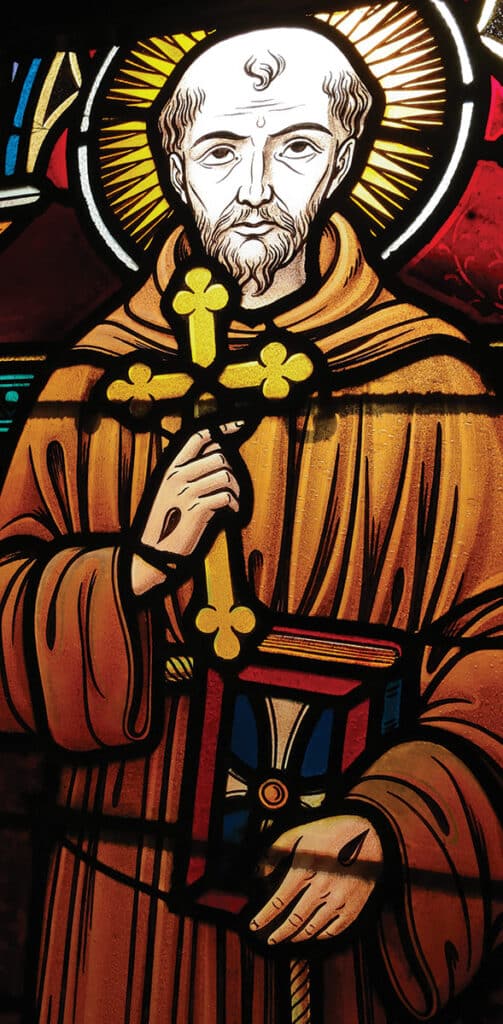
Stained glass window depicting St. Francis of Assisi with a cross, monk’s cloak, and stigmata. This window is located in the Church of Brasschaat, Belgium
For St. Francis, the spiritual life was a journey back to the Most High, God the Father, through the power of the Holy Spirit with Christ marking the route before us. Later Franciscans such as St. Alexander of Hales, St. Bonaventure, and Blessed John Duns Scotus, among others, considered learning and formation connected to Christ as the basic path of this journey. Thus, firstly, a Franciscan education is an invitation to a journey of faith. Francis expressed this journey in a prayer given to his brotherhood:
“Almighty, eternal, just and merciful God, grant us in our misery that we may do for your sake alone what we know you want us to do, and always want what pleases you; so that, cleansed and enlightened interiorly and fired with the flame of the Holy Spirit, we may be able to follow in the footprints of your Son, Our Lord Jesus Christ, and so make our way to you, Most High, by your grace alone, you who live and rule in perfect Trinity and simple Unity, and are glorified, God all-powerful, for ever and ever. Amen.”
A Franciscan education also recognizes the sacramentality of the human person and all of God’s creation as an expression of God’s generosity and goodness. Learning is to be shared generously for the benefit of others in the body of Christ. Learning is approached from a stance of humility, for we always have more to learn.
A Franciscan education aims to direct all disciplines to charity, the love of God and love of neighbor. In his Commentary on the Sentences, St. Bonaventure wrote, “Great as the intellect is in itself, its nature is to move the affect … to move a person to love.” Studies are not an end in themselves, but they enable students to be at the service of Divine Love in living out their call as an engi – neer, nurse, teacher, or professional in any field.
A Franciscan education has the purpose of forming the whole person. As the Franciscan Brothers of Brooklyn describe it:
“Like the preaching of St. Francis, Franciscan education is more than informative; it is transformative. It rejects the secular model of ‘value-neutral’ education and is committed to a more traditional understanding of education as the value-based intellectual, moral, and spiritual formation of men and women: formation that is ongoing and lifelong; formation that leads to an ever greater openness to truth, beauty, goodness, and love.”
Most of all, a Franciscan education leads students on the journey of wisdom. Wisdom is a virtue given by grace as learning meets faith and devotion. A student at Franciscan University moves forward from here to share with the world the gift of learning, enriching all they meet and leading others to desire an embrace of Jesus Christ, the Wisdom of God.
—Father Jonathan St. André, TOR ’96
Vice President of Franciscan Life
Embracing the Leper
One day when Francis was praying in the caves above Assisi, the Lord brought to mind the lepers in the valley below. The lepers represented everything Francis detested. They had no power, respect, or influence. They repulsed him. But Francis heard the Lord say to him, “I can make that which is bitter, sweet.”
The next time Francis saw a leper approaching, he did not turn away as he always did. Instead, he felt compelled to embrace the leper, and when he did, he encountered Jesus himself. God made that which was so bitter to Francis, sweet.
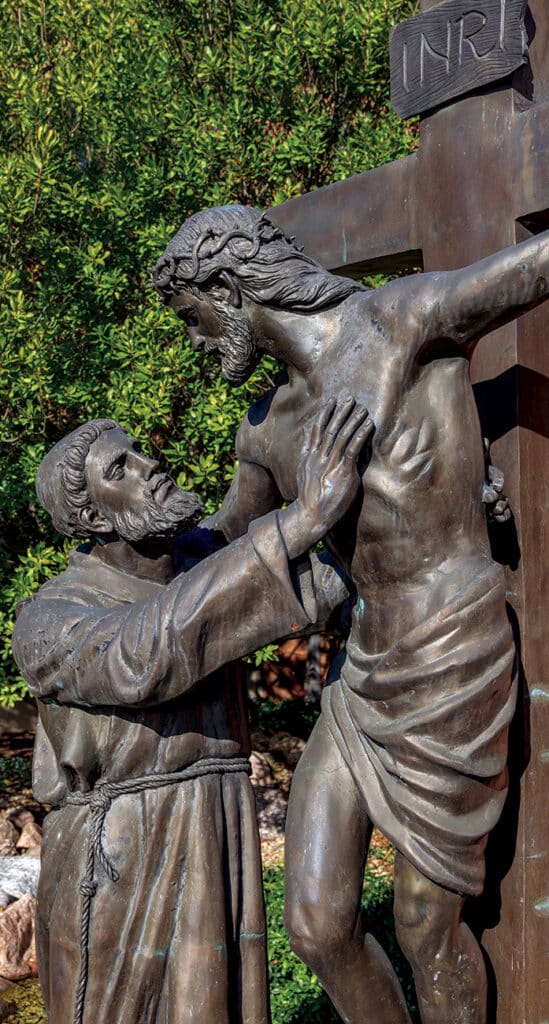
Bronze statue of St. Francis with the crucified Christ, Holy Spirit Friary, Franciscan University
Think about this. How would our lives be different if we let God make bitter things sweet? I am not suggesting we can go through life with no bitterness. Francis had some very bitter pills to swallow in his life, but he allowed God to make them sweet. That’s really the grace of his experience. It wasn’t that God protected him from difficulty; rather, God showed his mercy and love by transforming these difficulties.
This is seen most clearly in his stigmata. At La Verna, two years before his death, Francis was praying he would know the depths of God’s love—and God gave him the stigmata, the wounds of Christ’s passion and death. Yet, that which is most bitter becomes that which is most sweet, and Francis discovered the love of God in the agony of the cross. Ever after, he saw the cross profoundly differently.
We spend so much time praying that God will protect us from bitter things or take them away. Perhaps “taking them away” means allowing him to make them sweet. I can’t say I know exactly what that looks like for each of us, but I believe in a God who can do amazing things. Perhaps your anger toward a family member changes to mercy or compassion. A regret of the past becomes wisdom for moving forward. The loss of a job opens you to a satisfying new career path. Whatever the situation, whatever’s bitter, Lord, please make it sweet.
—Father Dave Pivonka, TOR ’89
President
Customer Service in the Spirit of St. Francis
In the early 1990s, our Franciscan University Conference and Events Office began the early stages of formal customer service training for student workers and staff. We attended customer service seminars and read books and articles written by the pros—Lisa Ford, Tom Peters, and Stephen Covey.
Several years later, I began brainstorming with David Schmiesing ’92 MS ’00, now dean for Personal Vocations but then working in the Conference and Events Office. We believed we were already doing well at meeting and even exceeding expectations, creating memories, and using a principle-centered approach to customer service. We also knew there had to be “something more.” So, what was next?
We enlisted the aid of Father Dan Pattee, TOR, then a professor in our Theology Department, asking him, “Is there any connection or correlation between customer service and St. Francis?” He immediately emailed us dozens of writings and articles of St. Francis, which became the inspiration for that something more.
In 1997, David aptly named our customer service culture as Customer Service in the Spirit of St. Francis. It’s not a program, and it’s not a fad. Customer Service in the Spirit of St. Francis IS a culture, a way of life.
As the late Father Michael Scanlan, TOR, president of Franciscan University from 1974–2000, wrote, “The freedom of the Franciscan way of life communicates the core values of the Gospel … saying to the world … there IS another way. … Francis found this way … the way of the Kingdom of God” (Let the Fire Fall).
This is what we try to live through Customer Service in the Spirit of St. Francis—and this is our “something more.” And there IS more…
Encounter: Father Mike was told by the holiest person he knew, Sister Caroline, superior of the Carmelite Sisters in Loretto, Pennsylvania, “You need to be baptized in the Holy Spirit,” an outpouring of the Spirit that creates a new intimacy with the Lord, a new power to love and minister to others, a power that helps to fuel our uniquely Franciscan customer service.
Conversion: As President Father Dave Pivonka, TOR ’89, wrote, “Ultimately, we are invited to live our life continually open to conversion, metanoia” (Living Metanoia). This ongoing conversion is another ingredient of our Customer Service in the Spirit of St. Francis.
Community: Vice President of Franciscan Life Father Jonathan St. André, TOR ’96, once stated, “Our University family is being formed daily as joyful disciples in the power of the Holy Spirit. We live out this discipleship together IN community and AS a community. This community becomes manifest in our desire to be of one mind and one heart even with all our differences. As we are rooted in Christ, the evidence of community is the visibility of the fruits of the Holy Spirit among us—love, joy, peace, patience, kindness, gentleness, self-control. Community is the place of encounter and the context for conversion.”
We strive to embody this community in our Customer Service in the Spirit of St. Francis, which is fueled also by the command of Jesus to love all unconditionally, including our lepers and enemies!
Ultimately, Customer Service in the Spirit of St. Francis is a one-of-a-kind culture in which we strive to be Christ to all … a culture inspired by St. Francis and propelled by Encounter, Conversion, Community, and unconditional love. Let us begin!
—Dave Fatula
Events Coordinator
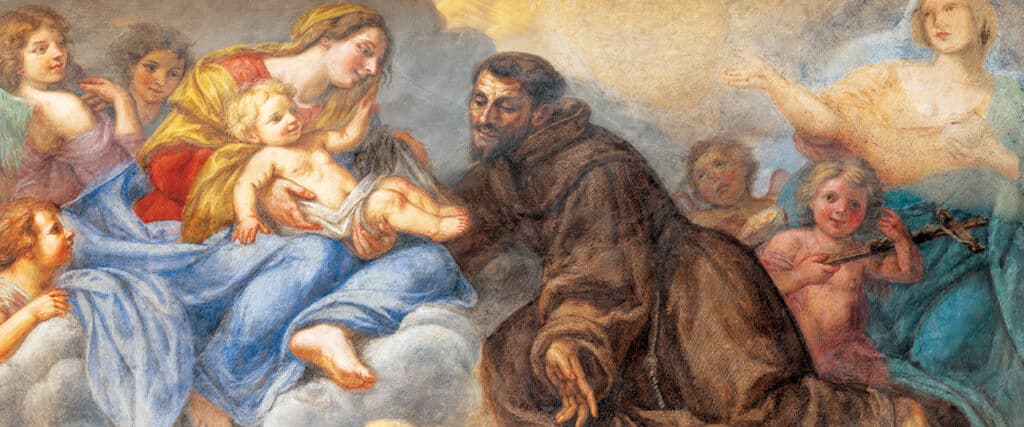
The fresco of St. Francis of Assisi With the Madonna in the Church of All Saints in Florence by Cosimo Ulivelli (1662).
Joy in Penance
My views of, and interest in, St. Francis have changed over my years of study. At first, I remember being completely amazed at his radical response to Christ’s invitation to follow him. That he physically and materially gave up everything to follow Our Lord, even renouncing his familial ties when they stood between himself and Christ, has always been inspiring and a strong challenge in my personal life. However, as I’ve aged, I find myself being more moved by the joy he experienced in doing penance. I often struggle in Lent with the Church’s invitation to penance. But St. Francis joyfully performed penitential acts as a response to God’s love for him. He understood penance to be the only proper response one could have when presented with God’s infinite love. Francis’ works of penance are so moving because, as I understand it, he embraced penance as the only appropriate gift that he could offer to God as an expression of his love for God.
—Dr. James Matenaer
Professor of History
Pathologically Helpful
One day, several years ago, I went on an errand to Starvaggi Hall. At this time, the Admissions Office was located on the top floor. In the Admissions lobby, I heard a student worker giving directions to guests here for a college visit. She addressed the small group and gave each a folder of information and directions to nearby Egan Hall. “Go across the plaza, into the vestibule, and up the main stairwell,” she said. “But don’t worry if you get a little lost; just ask for directions. Everyone here is pathologically helpful.”
I smiled to myself. “Pathologically helpful?” I had never heard it described better. Around here, we usually call it Service in the Spirit of St. Francis. But what does that mean? Ultimately, it means serving others as Christ would serve. As my colleague Dave Fatula says when onboarding new employees, “Say the prayer, live the prayer,” referring to the Peace Prayer inspired by St. Francis: “Lord, make me an instrument of your peace … to sow love … to pardon … to bring faith … hope … light … joy … to console … to understand … to give, and to die to ourselves for others so we can be born to eternal life.”
I’m a 1994 Franciscan graduate and have been an employee of Franciscan University for 13 years. I have watched “pathologically helpful service”—aka Service in the Spirit of St. Francis—lived out every day, again and again, online and in person, across this little campus hill in the Ohio Valley all the way to the alpine foothills of Gaming, Austria. I’ve seen countless students come to the “pardon” of their “injured” roommate, household member, or friend. I’ve watched University staff endeavor to help temper the hateful noise of popular culture with loving invitations to a healing community rich with joy, hope, faith, and the light of the sacraments. I have seen faculty help bring consolation and understanding to a world afflicted with doubt, despair, and darkness. I have seen the community of Franciscan University, one person at a time, one everyday task at a time, die to his or her own heavy “to-do list” to help Franciscan University “educate, evangelize, and send forth joyful disciples empowered by the Holy Spirit.”
In my own way, each day, I try to keep that student’s promise to our guests, to be “pathologically helpful,” however I can.
—Carrie Campbell Libetti ’94
Office Manager, Academic Affairs
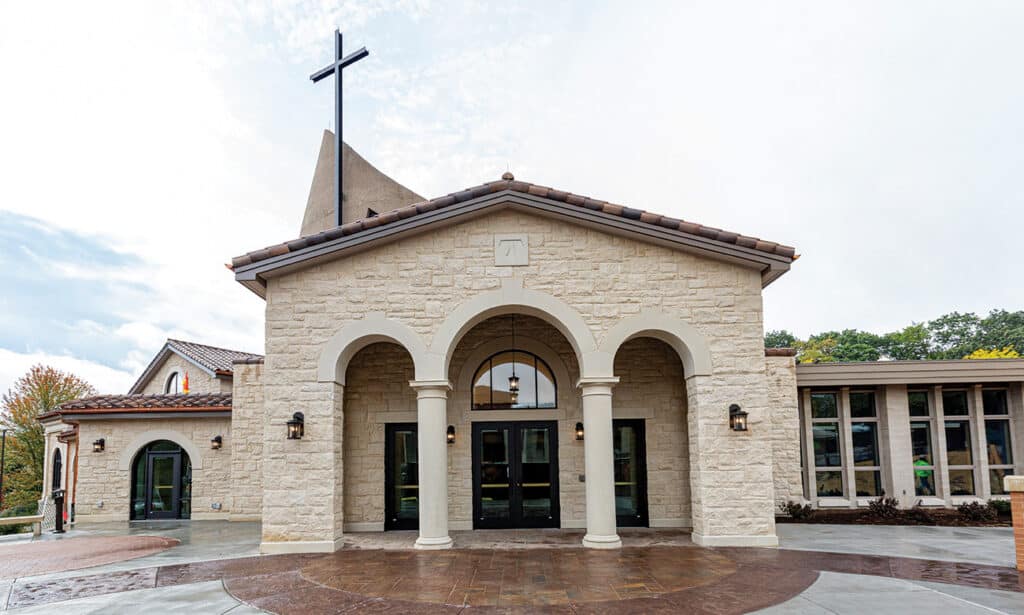
Christ the King Chapel



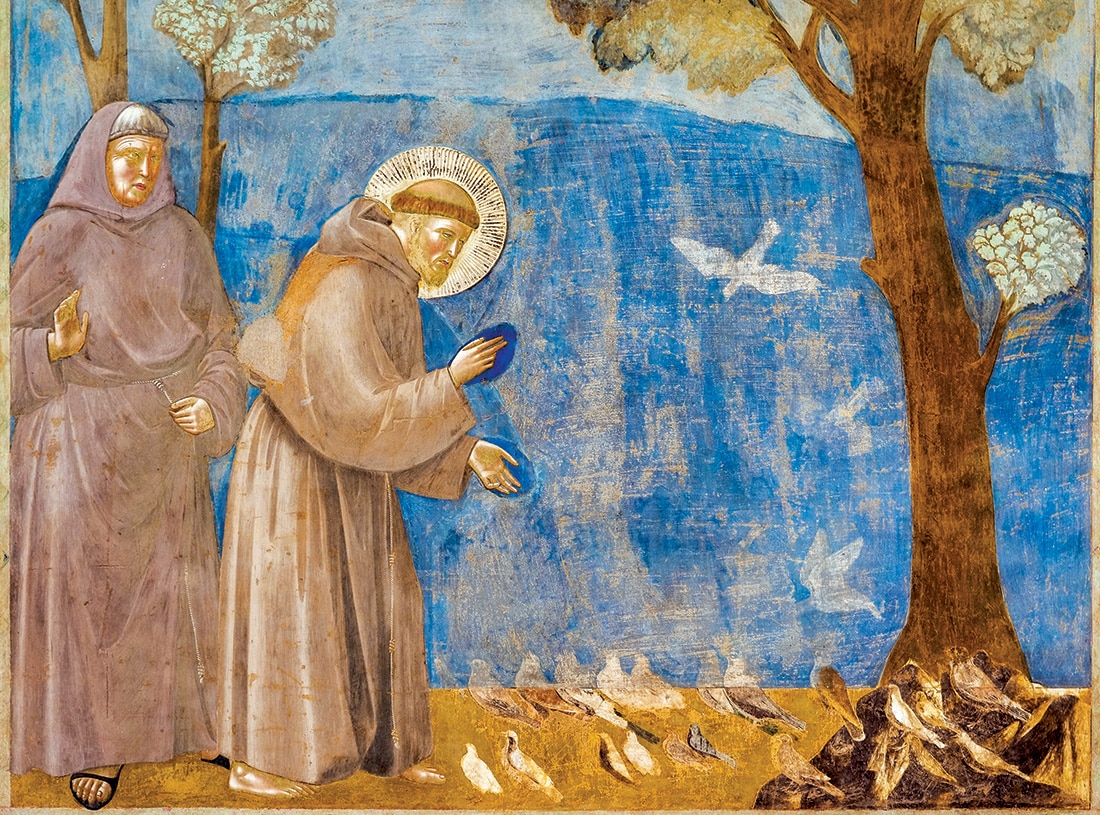
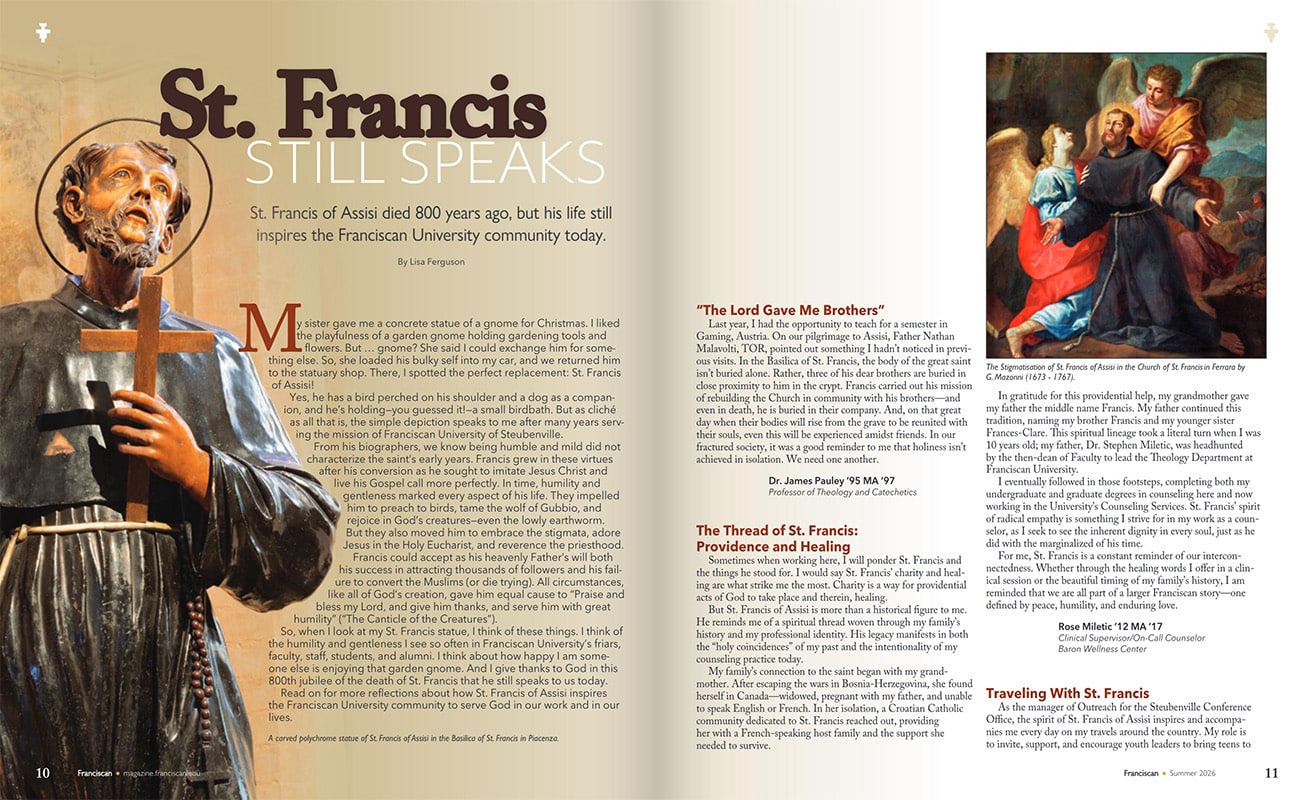
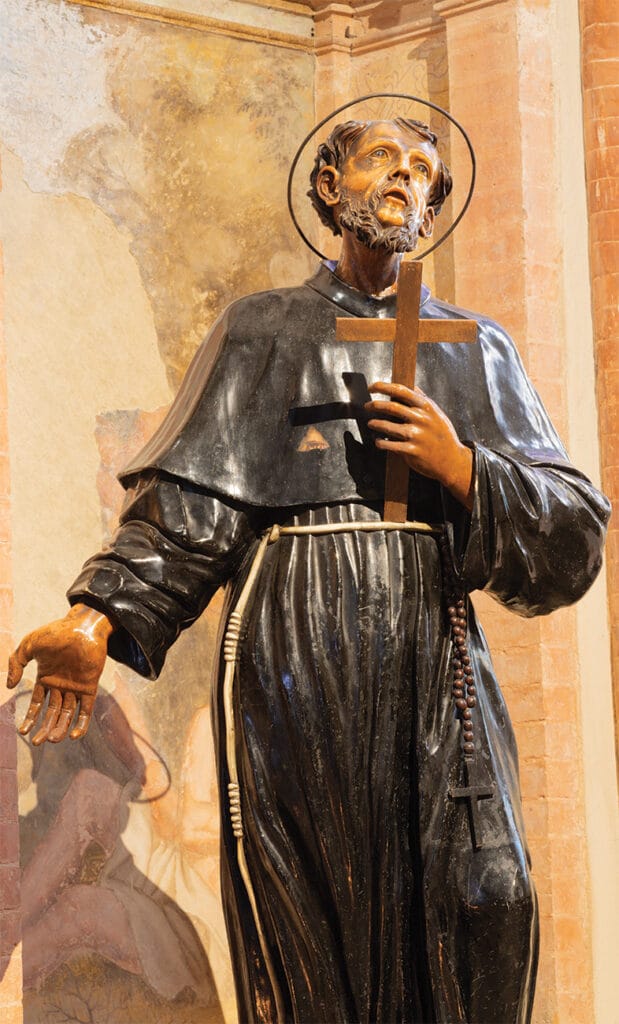 My sister gave me a concrete statue of a gnome for Christmas. I liked the playfulness of a garden gnome holding gardening tools and flowers. But … gnome? She said I could exchange him for something else. So, she loaded his bulky self into my car, and we returned him to the statuary shop. There, I spotted the perfect replacement: St. Francis of Assisi!