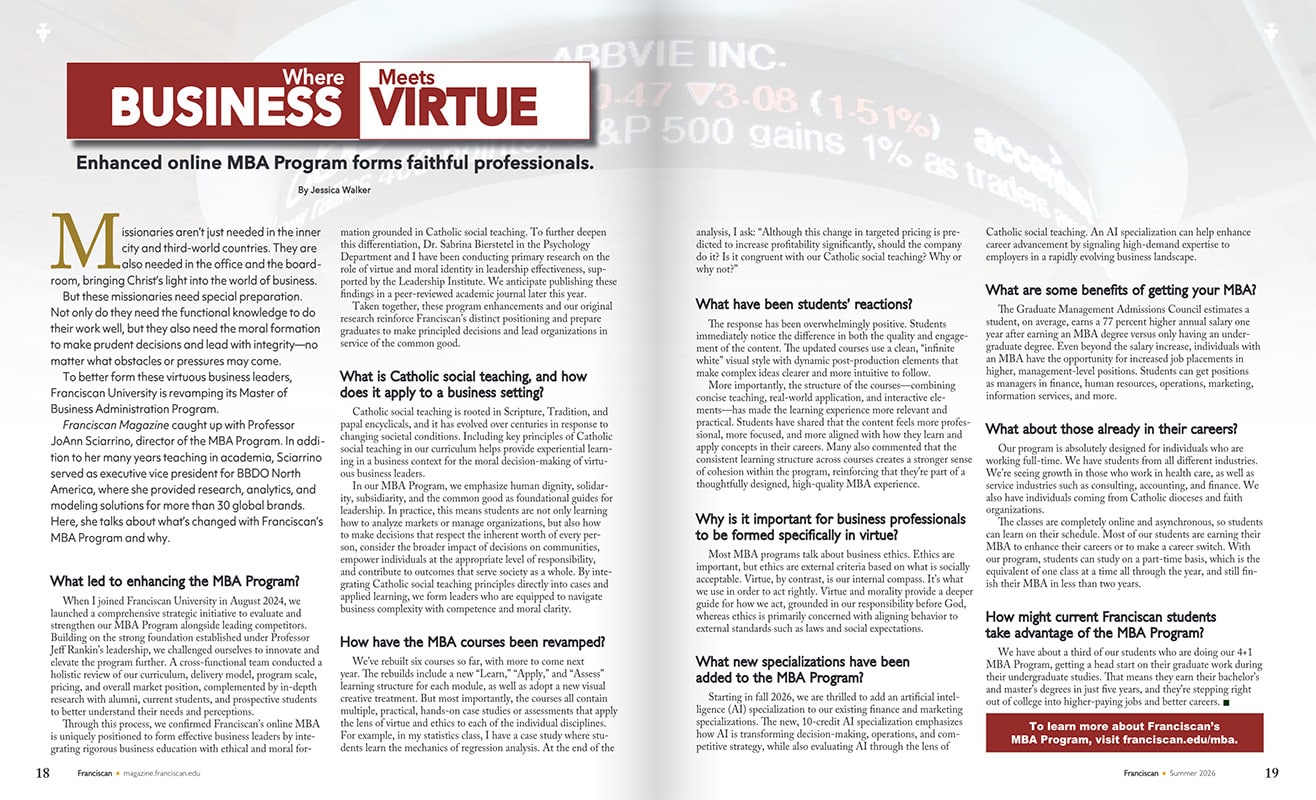


Missionaries aren’t just needed in the inner city and third-world countries. They are also needed in the office and the boardroom, bringing Christ’s light into the world of business.
But these missionaries need special preparation. Not only do they need the functional knowledge to do their work well, but they also need the moral formation to make prudent decisions and lead with integrity—no matter what obstacles or pressures may come.
To better form these virtuous business leaders, Franciscan University is revamping its Master of Business Administration Program.
Franciscan Magazine caught up with Professor JoAnn Sciarrino, director of the MBA Program. In addition to her many years teaching in academia, Sciarrino served as executive vice president for BBDO North America, where she provided research, analytics, and modeling solutions for more than 30 global brands. Here, she talks about what’s changed with Franciscan’s MBA Program and why.
What led to enhancing the MBA Program?
When I joined Franciscan University in August 2024, we launched a comprehensive strategic initiative to evaluate and strengthen our MBA Program alongside leading competitors. Building on the strong foundation established under Professor Jeff Rankin’s leadership, we challenged ourselves to innovate and elevate the program further. A cross-functional team conducted a holistic review of our curriculum, delivery model, program scale, pricing, and overall market position, complemented by in-depth research with alumni, current students, and prospective students to better understand their needs and perceptions.
Through this process, we confirmed Franciscan’s online MBA is uniquely positioned to form effective business leaders by integrating rigorous business education with ethical and moral formation grounded in Catholic social teaching. To further deepen this differentiation, Dr. Sabrina Bierstetel in the Psychology Department and I have been conducting primary research on the role of virtue and moral identity in leadership effectiveness, supported by the Leadership Institute. We anticipate publishing these findings in a peer-reviewed academic journal later this year.
Taken together, these program enhancements and our original research reinforce Franciscan’s distinct positioning and prepare graduates to make principled decisions and lead organizations in service of the common good.
What is Catholic social teaching, and how does it apply to a business setting?
Catholic social teaching is rooted in Scripture, Tradition, and papal encyclicals, and it has evolved over centuries in response to changing societal conditions. Including key principles of Catholic social teaching in our curriculum helps provide experiential learning in a business context for the moral decision-making of virtuous business leaders.
In our MBA Program, we emphasize human dignity, solidarity, subsidiarity, and the common good as foundational guides for leadership. In practice, this means students are not only learning how to analyze markets or manage organizations, but also how to make decisions that respect the inherent worth of every person, consider the broader impact of decisions on communities, empower individuals at the appropriate level of responsibility, and contribute to outcomes that serve society as a whole. By integrating Catholic social teaching principles directly into cases and applied learning, we form leaders who are equipped to navigate business complexity with competence and moral clarity.
How have the MBA courses been revamped?
We’ve rebuilt six courses so far, with more to come next year. The rebuilds include a new “Learn,” “Apply,” and “Assess” learning structure for each module, as well as adopt a new visual creative treatment. But most importantly, the courses all contain multiple, practical, hands-on case studies or assessments that apply the lens of virtue and ethics to each of the individual disciplines. For example, in my statistics class, I have a case study where students learn the mechanics of regression analysis. At the end of the analysis, I ask: “Although this change in targeted pricing is predicted to increase profitability significantly, should the company do it? Is it congruent with our Catholic social teaching? Why or why not?”
What have been students’ reactions?
The response has been overwhelmingly positive. Students immediately notice the difference in both the quality and engagement of the content. The updated courses use a clean, “infinite white” visual style with dynamic post-production elements that make complex ideas clearer and more intuitive to follow.
More importantly, the structure of the courses—combining concise teaching, real-world application, and interactive elements—has made the learning experience more relevant and practical. Students have shared that the content feels more professional, more focused, and more aligned with how they learn and apply concepts in their careers. Many also commented that the consistent learning structure across courses creates a stronger sense of cohesion within the program, reinforcing that they’re part of a thoughtfully designed, high-quality MBA experience.
Why is it important for business professionals to be formed specifically in virtue?
Most MBA programs talk about business ethics. Ethics are important, but ethics are external criteria based on what is socially acceptable. Virtue, by contrast, is our internal compass. It’s what we use in order to act rightly. Virtue and morality provide a deeper guide for how we act, grounded in our responsibility before God, whereas ethics is primarily concerned with aligning behavior to external standards such as laws and social expectations.
What new specializations have been added to the MBA Program?
Starting in fall 2026, we are thrilled to add an artificial intelligence (AI) specialization to our existing finance and marketing specializations. The new, 10-credit AI specialization emphasizes how AI is transforming decision-making, operations, and competitive strategy, while also evaluating AI through the lens of Catholic social teaching. An AI specialization can help enhance career advancement by signaling high-demand expertise to employers in a rapidly evolving business landscape.
What are some benefits of getting your MBA?
The Graduate Management Admissions Council estimates a student, on average, earns a 77 percent higher annual salary one year after earning an MBA degree versus only having an undergraduate degree. Even beyond the salary increase, individuals with an MBA have the opportunity for increased job placements in higher, management-level positions. Students can get positions as managers in finance, human resources, operations, marketing, information services, and more.
What about those already in their careers?
Our program is absolutely designed for individuals who are working full-time. We have students from all different industries. We’re seeing growth in those who work in health care, as well as service industries such as consulting, accounting, and finance. We also have individuals coming from Catholic dioceses and faith organizations.
The classes are completely online and asynchronous, so students can learn on their schedule. Most of our students are earning their MBA to enhance their careers or to make a career switch. With our program, students can study on a part-time basis, which is the equivalent of one class at a time all through the year, and still finish their MBA in less than two years.
How might current Franciscan students take advantage of the MBA Program?
We have about a third of our students who are doing our 4+1 MBA Program, getting a head start on their graduate work during their undergraduate studies. That means they earn their bachelor’s and master’s degrees in just five years, and they’re stepping right out of college into higher-paying jobs and better careers.
To learn more about Franciscan’s MBA Program, visit the program page here.