Franciscan Magazine
Franciscan University of Steubenville



In Brief
In Brief–Summer 2026
In Brief–Summer 2026
A look at recent news from the Franciscan University community.
Summer 2026
Criminal Justice Students Gain Real-World Experience
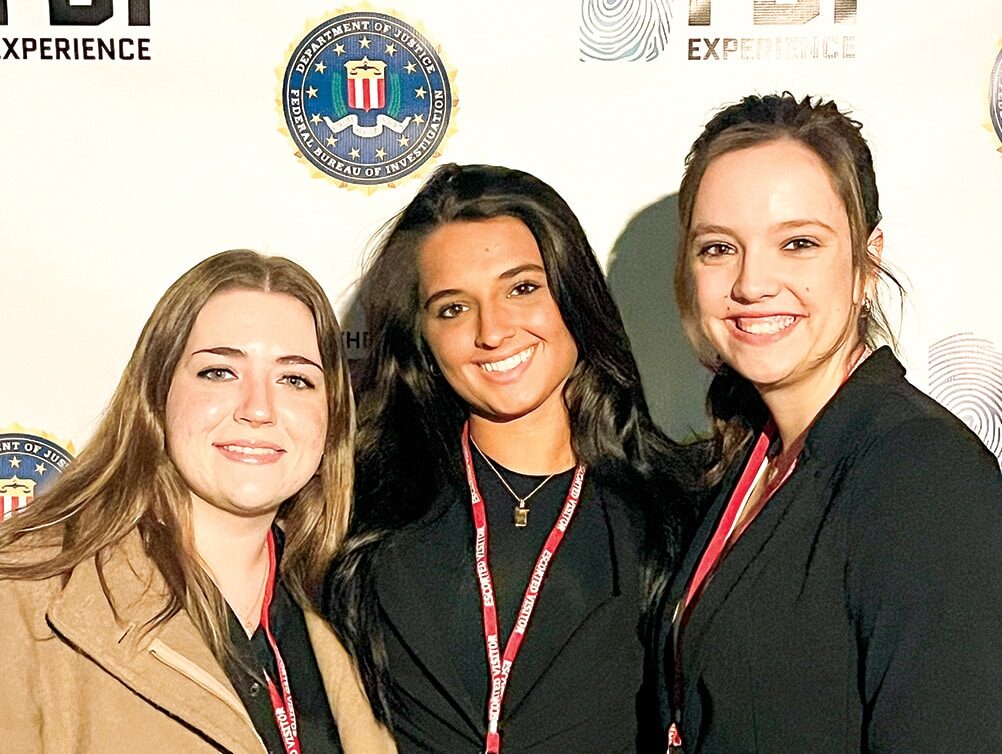
Students in the Criminal Justice Program recently traveled to Washington, D.C., where they combined academic formation, professional networking, and spiritual growth during a multi-day visit based at the Franciscan University Homeland Mission.
The trip began with an evening of fellowship and professional development at the mission, where U.S. Secret Service Special Agent Joey Routh ’03 and his wife, Attorney Jennifer (Butler ’05) Routh, led a conversation on workplace expectations and career navigation—particularly within the fast-paced environment of the nation’s capital. Their insights reinforced the program’s emphasis on professionalism and preparation, and students responded with thoughtful questions and strong engagement.
Over the following days, the 19 students experienced an intensive and immersive schedule. A visit to the Federal Bureau of Investigation provided rare opportunities to interact with retired agents, allowing for extended conversations about careers in federal law enforcement.
“Traveling to Washington, D.C., with the Franciscan University Criminal Justice Department gave me a deeper and more personal understanding of the wide range of careers available within our field of study,” said senior Veronica Saunders. “The opportunity to engage firsthand with lawyers, Capitol Police, FBI agents, and Secret Service made this experience especially valuable.”
One of the most impactful experiences for Saunders and her fellow classmates came during a visit to the United States Secret Service, where students learned about the agency’s mission and engaged directly with its recruitment team. These conversations have already opened doors for future opportunities, including a planned visit to the agency’s training facility and the White House.
The group also explored the judicial and legislative branches of government. At the Supreme Court of the United States, students toured the building, sat in the courtroom, and learned about career pathways in federal law enforcement. At the United States Capitol, they gained access to areas not typically open to the public, observed a House vote, and even stood on the chamber floor where the State of the Union is delivered.
Daily Mass and prayer remained central to the trip, including liturgies at the mission and at St. Joseph’s Church on Capitol Hill, grounding the experience in the University’s Catholic mission.
The visit concluded with an evening reception that brought together alumni, mentors, and supporters of the program, including former Ambassador Andrew Bremberg ’01. Students engaged in meaningful conversations, strengthening connections that will support their vocational discernment and professional futures.
Graduate nursing students also traveled to the Homeland Mission during the spring semester to participate in advocacy efforts on Capitol Hill, lending their voices in support of nurse practitioners and physician assistants in Ohio. They were directly engaged in the legislative process, gaining experience in policy advocacy, which is vital to professional growth and leadership development.
These experiences highlighted the growing impact of the Homeland Mission in equipping students to bring their Catholic formation into public service and leadership.
Riley Gaines to Students: ‘‘Know, Speak, and Live the Truth’’
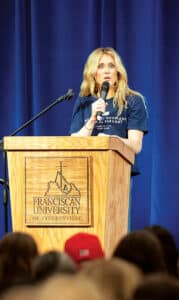
Riley Gaines, women’s sports advocate
A packed crowd filled the Pope St. Paul VI Event Center at Christ the Teacher Hall on March 3 as former NCAA swimmer and cultural commentator Riley Gaines addressed students, faculty, and visitors. Speaking candidly about faith, courage, and the future of women’s sports, Gaines urged the audience to remain steadfast in truth and resist cultural complacency.
“What a blessing it is to be here,” Gaines told the audience, noting that many of her campus appearances have been marked by hostility. At one university, she recounted, protesters rushed into the room where she was speaking, turned off the lights, and physically accosted her.
“So when I say I’m grateful to be here,” she said, “please know I really do mean that from the very bottom of my heart.”
Gaines, a 12-time NCAA All-American swimmer from the University of Kentucky, shared how her experience competing against a male athlete in the women’s division during the 2022 NCAA championships became a turning point in her life. After tying in the 200-yard freestyle, she said an NCAA official informed her that although the swimmers had tied, only one trophy would be awarded.
“‘Great job, you two, but you tied, and we don’t account for ties. We only have one trophy. So, we’re going to give the trophy to him,’” Gaines recalled the official saying.
“That was the moment when I was really unwilling to wait for someone else,” she told the audience. “How in the world can you expect someone to stand up for you if you’re not even willing to stand up for you?”
Beyond the competition itself, Gaines said the situation also raised concerns about privacy and fairness in women’s sports, including the experience of sharing locker room space with male athletes.
In the years since, Gaines has become a national voice advocating for women’s athletics and speaking about broader cultural questions surrounding gender ideology. During her talk, she framed those debates within a spiritual context.
“Gender ideology, it is an evil lie,” she said. “It’s a lie that is built on deception and discouragement and destruction.”
She contrasted that message with the Christian understanding of human dignity.
“We should be telling them that they were created uniquely and intentionally in God’s perfect image,” she said.
Gaines also reflected on how her own life has changed in recent years. Once focused almost entirely on athletics, she never expected to become a public speaker or activist.
“This is never what I wanted to do,” she admitted. “By no means did I feel prepared for this.” Yet, she has come to see God’s providence at work in her unexpected path: “He doesn’t call the prepared. He prepares those he calls.”
Now a wife and mother of a young daughter, Gaines said her family gives her renewed motivation to continue speaking out.
“Having a little daughter, that’s who we’re fighting for,” she said.
Throughout the evening, Gaines encouraged students to remain engaged in cultural debates and public life, especially at the local level. She urged them not to assume the challenges facing society will simply disappear.
“Don’t become complacent,” she said. “Success breeds complacency, but complacency breeds failure.”
For Gaines, the answer lies in the Christian witness Franciscan students are called to embody.
“How do we combat that?” she asked. “We do that, number one, by knowing the truth. Secondly, by speaking the truth. And third, by living the truth.”
The World Comes to Campus
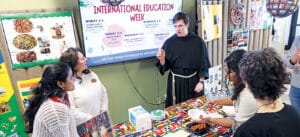
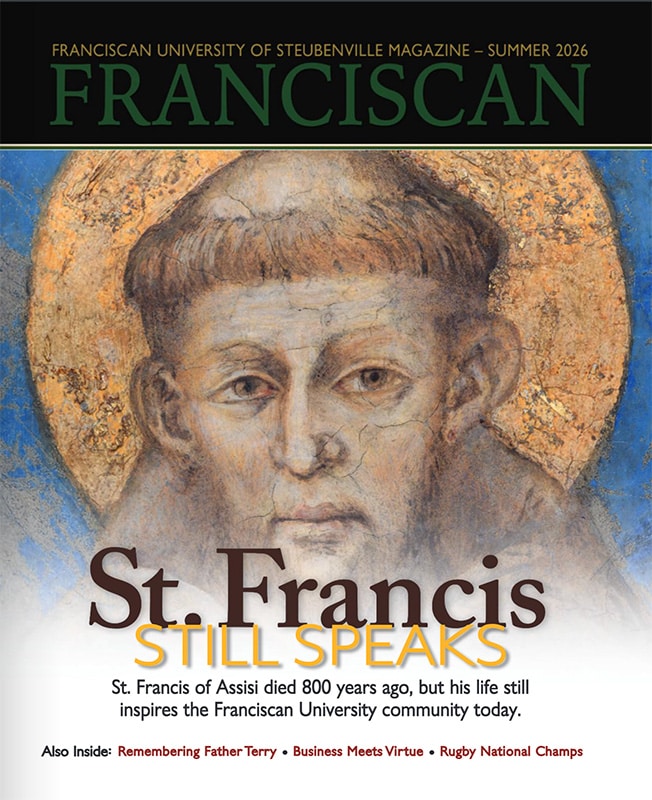
International student Rosa Pallan, Assistant Vice President for Student Life and Event Services Julianna Daugherty, and Brother Moses Hermann, TOR, enjoy the international showcase and food tasting event during International Education Week.
When Rosa Pallan left Delhi, India, and traveled more than 7,000 miles to attend Franciscan University, she knew she was coming to her dream school.
“For studying theology, this is the place to be,” says Pallan, now enrolled in the Master of Arts in Theology and Christian Ministry Program. “The authentically Catholic environment and intentional formation opportunities were a big part of what led me here.”
Still, arriving in the United States in January 2025 meant adapting to an unfamiliar culture. Everyday details—from unit conversions to social customs—felt new. Yet one thing remained constant.
“Settling in was so much easier with the faith community and knowing that, wherever I go, the Mass remains the same,” she says. “The Catholic faith unites us.”
Pallan’s story reflected the spirit of Franciscan University’s new International Students Week, a campuswide celebration highlighting the growing global presence of the University and the shared faith that connects students from around the world.
One of the week’s signature events was a country showcase featuring student presentations on their homelands and experiences studying in the United States. Posters represented nations including India, Belize, Zimbabwe, Brazil, and Iraq. Pallan also shared homemade gulab jamun and mango rasmalai alongside fellow Indian student Krysanne Martis, offering classmates a taste of home.
Another centerpiece of the week was a panel discussion on careers with a global mindset. International faculty and staff members—including Dr. Joseph Pathakamuri, Dr. Bartosz Langowski, Dr. Valerie Plaus, Professor José Roberto Lopez, and Ronald McNamara—shared stories of relocating across borders, adapting to new cultures, and remaining grounded in faith.
Their message was clear: professional success and cultural mobility are strengthened by a firm spiritual foundation.
For Juliana Daugherty, assistant vice president for Student Life and Event Services and immigration specialist, the celebration pointed to something deeper than programming.
“This week underscores the University’s shared mission: helping students see global education as an integral part of a Franciscan vision rooted in faith, community, and service to the Church and world,” Daugherty said.
That mission is increasingly visible on campus. Since spring 2024, Franciscan University has welcomed 26 additional F-1 visa students and expanded representation by 9 countries. Today, 71 F-1 visa students from 28 nations study at Franciscan.
March for Life
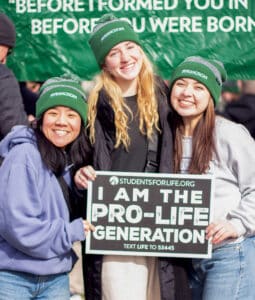
Leia Kadelak, Jill Nichols, and Angeles Gonzalez-Ansaldi stand up for babies and moms in Washington, D.C.
More than 700 Franciscan University of Steubenville students, alumni, faculty, and staff attended the national March for Life on Friday, January 23, in Washington, D.C. Events began on campus Thursday, January 22, with a pro-life Holy Hour. Then, seven busloads of students left for D.C. and arrived in time to attend the morning Mass for Life at the Basilica of the National Shrine of the Immaculate Conception before spending the day marching for life. “The number of students who attend the march is truly incredible. Each year brings Franciscan’s faithful witness to the gift of human life,” said Michaela Shovak, president of Franciscan University’s Students for Life club.
Nurture Your Soul and Mind
Franciscan University’s FaithandReason.com continues to expand with new and upcoming programs designed to help viewers grow in both faith and understanding through engaging Catholic content.
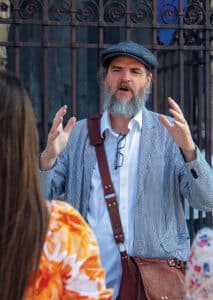
Professor Carl Fougerousse teaches students at Notre Dame de Chartres Cathedral in a new video on Gothic architecture.
Among the newest releases is Height and Light in the House of God, featuring engineering professor Dr. Justin Greenly and art history professor Carl Fougerousse ’98. Filmed at the Kartause Maria Thronus Iesu, Franciscan University’s Austrian study abroad site, the video explores the mystery and majesty of Gothic cathedrals such as Notre-Dame de Paris, Chartres, and Amiens, examining how medieval builders created soaring beauty with simple tools and enduring faith.
In another timely conversation, In Focus welcomed Dr. Robert P. George of Princeton University for an episode titled “TruthSeeking in the Age of Feeling.” Speaking with President Father Dave Pivonka, TOR ’89, George addresses the modern rejection of objective truth, the importance of civil disagreement, and how Christians can speak truth with both conviction and charity.
Also recently released is a new episode of In Person, in which former All-American swimmer Riley Gaines reflects on her experience competing against a biological male at the 2022 NCAA Championships and discusses courage, motherhood, prayer, and the defense of fairness in women’s sports.
FaithandReason.com also continues to offer rich ongoing podcast content. In The Spirit and the Bride, retired Franciscan theology professor Dr. Alan Schreck is continuing his Catechism Alive series based on his book The Essential Catholic Catechism.
Coming later this summer, a new season of The Purposeful Lab will feature biology professor Dr. Dan Kuebler and guest experts examining mental health and human flourishing through the lens of Catholic faith and modern science.
Franciscan Saint
Blessed Patrick O’Hely (c. 1543–1579)
Ireland’s most famous bishop named Patrick is, no doubt, the fifth-century missionary celebrated annually on March 17 with parades and festivities. But a millennium later, another Patrick also had a desire to spread the faith throughout the Emerald Isle.
Born sometime around 1543 near Creevelea Abbey, Patrick O’Hely joined the Franciscan order from a young age. He excelled as a student and, not long after his profession of vows, he was sent to Rome. Once there, the order’s minister general recognized Patrick’s brilliance and sent him to a Franciscan province in Spain for further studies. There, he spent many years studying grammar, philosophy, and sacred studies.
In 1576, Patrick was called to meet with Pope Gregory XIII, who made him bishop of Mayo in Ireland. At the time, the Catholic Church in Ireland was suppressed due to Elizabethan-era persecution.
Around 1579, Bishop Patrick sailed for his homeland with fellow Franciscan friar Conn O’Rourke. Upon their arrival near Askeaton, the Countess of Desmond hosted them at her castle. However, most likely due to fear of retribution, she told local authorities about the Franciscans. They were seized and sent to Kilmallock.
Initially, Lord Justice Sir William Drury said Bishop Patrick could assume leadership of his see if he took an oath acknowledging royal supremacy and promised to tell Drury about all his business with the Vatican. Bishop Patrick replied he would not barter his faith for anything, even his life, and his only business was to save souls. Infuriated, Drury turned the Franciscans over to cruel torture.
Bishop Patrick and Friar Conn remained steadfast in their faith throughout their suffering. They were condemned to execution by martial law and hung outside the gates of Kilmallock. In 1992, they were beatified along with other Irish Catholic martyrs by Pope John Paul II. The Irish Catholic martyrs’ feast day is on June 20.
Bookshelf
Training the Tongue and Growing Beyond Sins of Speech
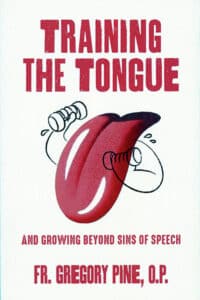
God gave us our speech to foster relationship with him and with others. Unfortunately, our speech can also be a great source of sin—gossip, cursing, lying—and we often feel powerless to stop. So, how can we avoid sins of speech and instead cultivate virtue in our communication? Father Gregory Pine, OP, gives practical advice on how we can temper our tongue and improve our speech in our daily conversations, whether we’re sharing the truth, talking about others, giving loving correction, or telling a joke.
Evolutionary Theology: A Critical Introduction
Michael Anthony Abril ’06 MA ’08
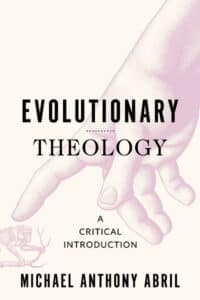
Where does the scientific theory of evolution meet faith? In his book, Dr. Michael Anthony Abril, professor of systematic theology at Aquinas Institute of Theology, unpacks the interdisciplinary field of evolutionary theology. He highlights how different theologians and thinkers over the recent centuries have approached evolution and understood it in relation to God, the human race, and the natural world. Evolutionary Theology provides a critical synthesis of the topic that is ideal for scholars and students who are curious about the intersection of science and faith.
Wish I Was Here
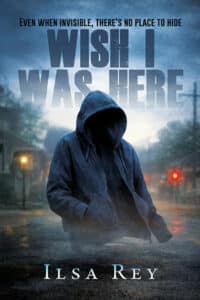
Betsy (Russell ’00) Kerekes
Black Rose Writing
Alumna Betsy Kerekes, writing as Ilsa Rey, kicks off her Wish Trilogy with Wish I Was Here. In this suspenseful young adult novel, Ana watches her genius friend, Isaac, get taken by mysterious men. To avoid capture, she swallows his invisibility pill. The problem? The effects will become permanent unless she can find Isaac for the antidote within a week—and the kidnappers are now after her, too. Ana must follow the twists and turns of Isaac’s clues, uncover secrets, and decide whether to trust police officer Ben with the truth before time runs out.
Designing Farms in Space
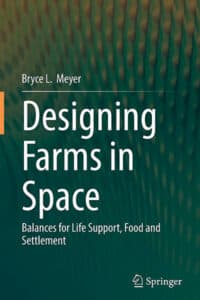
If space is the final frontier, how will we live and eat there? Bryce Meyer, visiting engineering professor and research director for AI and cybersecurity at Franciscan, explores the possibility of and the science behind space settlements in his new book, Designing Farms in Space.
Drawing from principles of chemistry, biology, and engineering, he highlights how space architects could create synthetic ecologies that grow crops while recycling air, water, and waste. He also covers possible scenarios that may arise from operating these types of farms.