Franciscan Magazine
Franciscan University of Steubenville



Cover Story
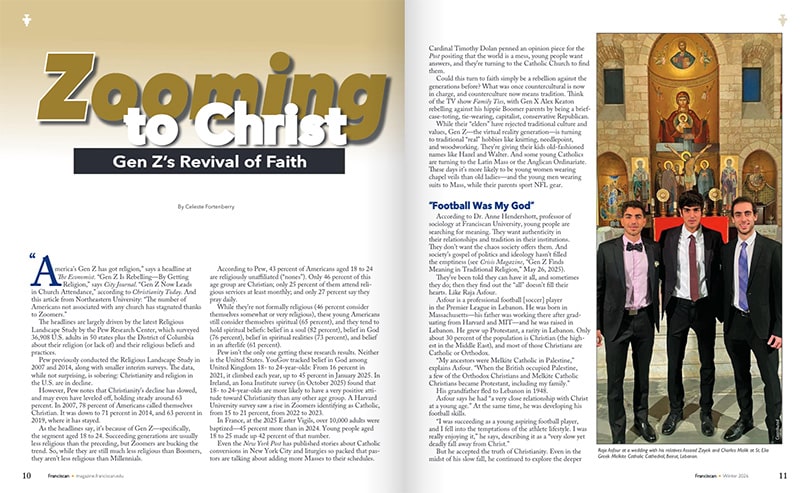
Zooming to Christ
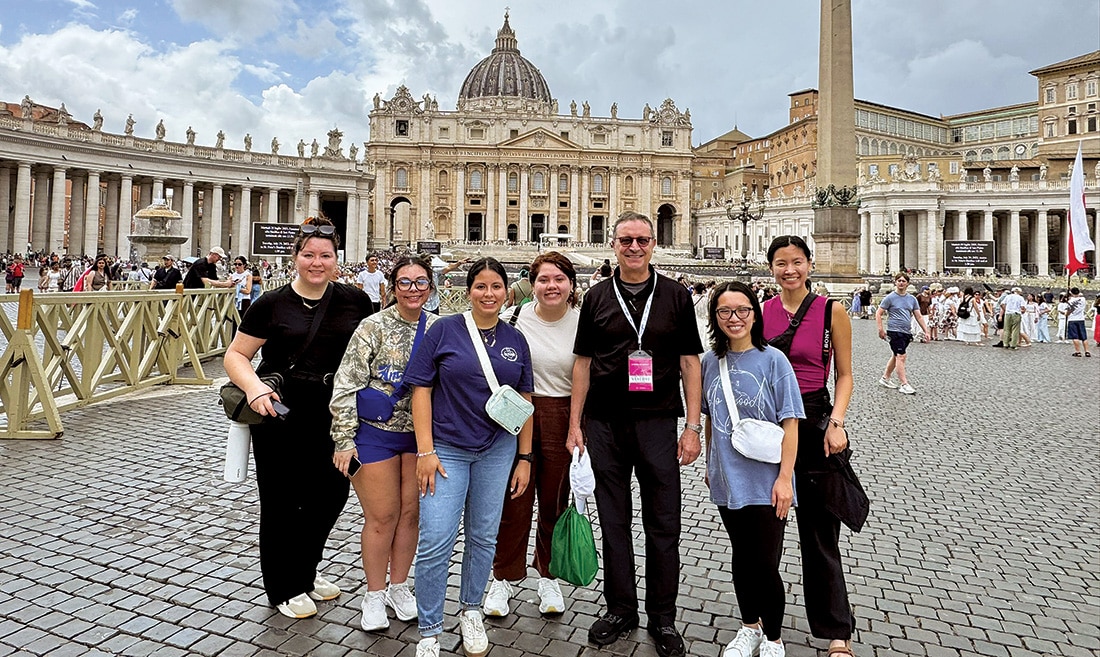
Zooming to Christ
What recent survey trends—and anecdotes—indicate about Gen Z and religion.
Winter 2026 | Celeste Fortenberry
America’s Gen Z has got religion,” says a headline at The Economist. “Gen Z Is Rebelling—By Getting Religion,” says City Journal. “Gen Z Now Leads in Church Attendance,” according to Christianity Today. And this article from Northeastern University: “The number of Americans not associated with any church has stagnated thanks to Zoomers.”
The headlines are largely driven by the latest Religious Landscape Study by the Pew Research Center, which surveyed 36,908 U.S. adults in 50 states plus the District of Columbia about their religion (or lack of) and their religious beliefs and practices.
Pew previously conducted the Religious Landscape Study in 2007 and 2014, along with smaller interim surveys. The data, while not surprising, is sobering: Christianity and religion in the U.S. are in decline.
However, Pew notes that Christianity’s decline has slowed, and may even have leveled off, holding steady around 63 percent. In 2007, 78 percent of Americans called themselves Christian. It was down to 71 percent in 2014, and 63 percent in 2019, where it has stayed.
As the headlines say, it’s because of Gen Z—specifically, the segment aged 18 to 24. Succeeding generations are usually less religious than the preceding, but Zoomers are bucking the trend. So, while they are still much less religious than Boomers, they aren’t less religious than Millennials.
According to Pew, 43 percent of Americans aged 18 to 24 are religiously unaffiliated (“nones”). Only 46 percent of this age group are Christian; only 25 percent of them attend religious services at least monthly; and only 27 percent say they pray daily. While they’re not formally religious (46 percent consider themselves somewhat or very religious), these young Americans still consider themselves spiritual (65 percent), and they tend to hold spiritual beliefs: belief in a soul (82 percent), belief in God (76 percent), belief in spiritual realities (73 percent), and belief in an afterlife (61 percent).
Pew isn’t the only one getting these research results. Neither is the United States. YouGov tracked belief in God among United Kingdom 18- to 24-year-olds: From 16 percent in 2021, it climbed each year, up to 45 percent in January 2025. In Ireland, an Iona Institute survey (in October 2025) found that 18- to 24-year-olds are more likely to have a very positive attitude toward Christianity than any other age group. A Harvard University survey saw a rise in Zoomers identifying as Catholic, from 15 to 21 percent, from 2022 to 2023.
In France, at the 2025 Easter Vigils, over 10,000 adults were baptized—45 percent more than in 2024. Young people aged 18 to 25 made up 42 percent of that number.
Even the New York Post has published stories about Catholic conversions in New York City and liturgies so packed that pastors are talking about adding more Masses to their schedules.
Cardinal Timothy Dolan penned an opinion piece for the Post positing that the world is a mess, young people want answers, and they’re turning to the Catholic Church to find them.
Could this turn to faith simply be a rebellion against the generations before? What was once countercultural is now in charge, and counterculture now means tradition. Think of the TV show Family Ties, with Gen X Alex Keaton rebelling against his hippie Boomer parents by being a briefcase-toting, tie-wearing, capitalist, conservative Republican.
While their “elders” have rejected traditional culture and values, Gen Z—the virtual reality generation—is turning to traditional “real” hobbies like knitting, needlepoint, and woodworking. They’re giving their kids old-fashioned names like Hazel and Walter. And some young Catholics are turning to the Latin Mass or the Anglican Ordinariate. These days it’s more likely to be young women wearing chapel veils than old ladies—and the young men wearing suits to Mass, while their parents sport NFL gear.
 “Football Was My God”
According to Dr. Anne Hendershott, professor of sociology at Franciscan University, young people are searching for meaning. They want authenticity in their relationships and tradition in their institutions. They don’t want the chaos society offers them. And society’s gospel of politics and ideology hasn’t filled the emptiness (see Crisis Magazine, “Gen Z Finds Meaning in Traditional Religion,” May 26, 2025).
They’ve been told they can have it all, and sometimes they do; then they find out the “all” doesn’t fill their hearts. Like Raja Asfour.
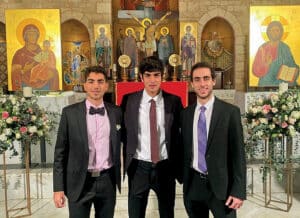
Asfour is a professional football [soccer] player in the Premier League in Lebanon. He was born in Massachusetts—his father was working there after graduating from Harvard and MIT—and he was raised in Lebanon. He grew up Protestant, a rarity in Lebanon. Only about 30 percent of the population is Christian (the highest in the Middle East), and most of those Christians are Catholic or Orthodox.
“My ancestors were Melkite Catholic in Palestine,” explains Asfour. “When the British occupied Palestine, a few of the Orthodox Christians and Melkite Catholic Christians became Protestant, including my family.”
His grandfather fled to Lebanon in 1948.
Asfour says he had “a very close relationship with Christ at a young age.” At the same time, he was developing his football skills.
“I was succeeding as a young aspiring football player, and I fell into the temptations of the athlete lifestyle. I was really enjoying it,” he says, describing it as a “very slow yet deadly fall away from Christ.”
But he accepted the truth of Christianity. Even in the midst of his slow fall, he continued to explore the deeper questions of life, especially during COVID lockdowns. He studied the arguments for Christianity versus atheism and Islam, and he became certain that Christianity is true.
Meanwhile, at 18, Asfour signed with a professional club in Serbia (FK Vojvodina) for a year and went pro a few years later.
“Football was my god,” says Asfour, “and I thought that this would finally satisfy me. I believed that my worth was in how I performed in football. But it did not fulfill my heart.”
Asfour has an aunt who leads a weekly Bible study that he attended growing up.
“I think she saw that I was falling away” as a teenager, says Asfour, although he tried to hide it from her. “When I went to Serbia to play football, I couldn’t attend the Bible studies anymore, but she would call me and encourage me to read and pray on my own.”
He didn’t take her seriously, at first. But he says, “When I realized I was still searching for my worth, to know that I am loved and seen and known, I decided to listen to her.”
Asfour’s conversion occurred while reading the Gospels alone in his room.
“I began to feel Christ’s presence with me very powerfully. I felt his presence with tremendous grace and mercy, and I understood how beloved I am. I wept for my sins and how I crucified Christ, yet this weeping turned to weeping for joy for what the Crucifixion did to my sins, how it washed them away.”
With the change of heart came a desire to know the faith more deeply, so Asfour began researching on his own.
“In Lebanon, there are many Orthodox and Catholic, and I was fascinated by the tradition they had.”
He stumbled on the stories and work of Dr. Scott Hahn and Dr. John Bergsma of Franciscan University’s Theology Department.
“Slowly, I started reading about Catholicism, and how everything they teach is very scriptural, which I had not thought was the case.”
He eventually decided to convert to Melkite Catholicism. It took about two years from that decision to being received into the Church. Not for lack of desire, though. He prayed novenas to St. Thérèse of Lisieux, and she sent him roses— roses that said, “Not yet,” then “Not yet, but soon,” and finally, “Yes, now.”
Asfour wanted to learn more about the faith while still playing pro football, so he registered to study theology online at Franciscan.
“The online option was exactly what I was looking for, since I could be continuing my career in whatever country the Lord sends me, while studying theology at the same time,” says Asfour. “Now, here I am playing in the Lebanese Premier League and studying sacred theology at Franciscan.”
Asfour credits the Mother of God with having a significant hand in his spiritual journey. “Our Lady has made a profound impact on my life, especially after becoming Catholic.”
Life as a committed Christian and professional athlete isn’t always easy; sometimes it’s quite difficult, he says, especially socially.
“In Lebanon, most of the football players are Muslims, and most of the basketball players are Christians. It’s just how it’s divided. But religion is very respected, even if they [pro athletes] don’t really practice their religion. So, if they see someone who is faithful, they respect that person, which is nice.”
Asfour says some of the decisions he’s made to be closer to God haven’t been the best for his career. He had the chance to play in the United Arab Emirates but opted instead to move back to Lebanon to be able to live with other faithful Christians.
Real Community
Raja Asfour’s choice to put his values and community over his career is a fairly typical Zoomer move. A 2023 Deloitte survey found that almost half of Gen Z workers would quit over dissatisfaction with the company’s values or their own work-life balance. They demand authenticity from themselves and others, from their jobs and coworkers, even the brands they support (or don’t support).
 Gen Z has mastered digital realities and digital communities. They’re the most connected generation. They’ve got online friends and followers and countless likes and swipes and endless scrolling. But they’re finding it doesn’t compare with being physically present and interacting with another person. The generation of filters, airbrushing, and deepfakes wants real life to be real.
Michael Assaf coordinates young adult offerings in the Diocese of Pittsburgh for Divine Grace Parish. He’s seen this desire for real relationships firsthand.
“Being a young adult is a time of extreme loneliness,” he says. “Young people are searching for something to give them meaning and purpose in a world where you’re just on your phone or your computer all the time. And I think when you find that genuine connection, you can talk about something real with someone.”
Assaf is working toward a master’s degree in theology and Christian ministry at Franciscan University. Along with his work at Divine Grace Parish, he heads a regional young adult group, Faith on Fire.
In his work, he’s seeing young adults showing up, making friends, and getting involved. They’re starting Bible studies, going on retreats, volunteering, and more. And they’re coming back.
“People are so lost nowadays,” says Assaf. “I think they are looking for something that grounds them. I think that’s what attracts people, and why they stay, because they make these connections. They make those friendships. And those friendships centered on Christ are so much stronger than a friendship that’s centered only on sports or activities.”
Nicole (Janecek MA ’24) Zaepfel is director of Youth and Young Adult Ministry at St. Gregory the Great in Williamsville, New York. Her young adult groups are growing; like Assaf, she’s noticed Zoomers’ desire to be with people in person.
“There are multiple stories of non-practicing or Protestant young adults coming to find a community and then entering into the faith,” she says. Last October, they held a retreat, and “50 young adults joined us for an entire weekend.”
Angela Pometto ’03 is the director of Young Adult and Campus Ministry in the Archdiocese of Galveston-Houston. She’s also seeing the faces and hearing the stories that drive Pew’s survey numbers.
“We are definitely seeing an increase in participation from our young adults,” says Pometto. “Many of them are already committed to the Church but don’t know how to live fully as a Catholic.”
Assaf says that not everyone who shows up is committed to the faith or is even Catholic. It’s people just starting the journey and people who’ve been on the journey. Both are looking for fellow-travelers. He says Faith on Fire holds purely social events, like their Christmas party, which are really popular, where it’s easy to invite a friend who isn’t Catholic. Other events go deeper, like the silent retreat they hold in Lent or a pilgrimage to Rome and Assisi.
Pometto says people shouldn’t be afraid to challenge young adults with the riches the Church has to offer.
“They aren’t content to stay in the shallow end, but just like in Luke 5, they want to ‘put out into the deep.’”
She’s also seeing young adults “come to the Church as a reaction against our current culture. They see the lies, the discontent, and the lack of peace that come from living in the world. They know they want something more from their lives, and they see that in the Catholic Church.”
Pometto says, “The best way to get people to attend an event is still a personal invitation. We always ask each team member to personally invite at least five friends to attend the event. This is the best way of spreading the word and encouraging young people to come.”
Assaf sees that, too.
“Sometimes that’s all it takes, that invitation. Not only do you feel like, oh, this could be something beautiful, but you feel like you belong because you were asked. Sometimes people are just waiting to be asked,” he says.
There’s the potential to meet new people and make new friends, and maybe even a future spouse. Zoomers with swipe fatigue are looking for real-life venues (or as they say, IRL) to meet nice people.
“We get a lot of people trying to find their vocation,” says Assaf. “I think people are tired of the dating apps. This is one of the few places you can meet someone you share values with.”
And it’s not just marriage vocations.
Assaf continues, “We’ve been blessed to have a number of marriages, a couple of men have entered the seminary, and we have someone becoming a consecrated virgin this year.”
Pew’s Religious Landscape Survey notes that 63 percent of the youngest adults have a deep sense of wonder about the universe. They have awe for the beauty of nature and a sense of the otherworldly. The Catholic Church has a rich tradition of beauty and transcendence in her art, music, architecture, and liturgies, not to mention the sacramental mysteries, and, most glorious of all, the Paschal Mystery itself. True to the survey findings, Zoomers are feeling the pull.
“We see that sense of wonder in young Catholics returning to some more traditional elements of the Church,” says Assaf. “We have a lot of Latin Mass-goers and a lot of people who pray the Liturgy of the Hours together. It’s a little return to tradition, where it’s less about entertaining yourself and all about worshiping the Almighty God. Working with youth, I see this growing sense of wonder and transcendence.”
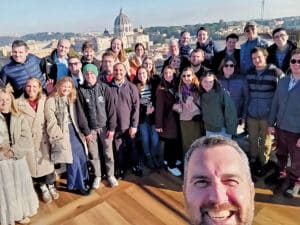
Pometto is seeing that young adults really care about the Church. They want to learn more about Church teaching on prayer, Theology of the Body, dating, and discernment. They want to dive into Scripture. This past summer she took 70 young adults to Rome for the Jubilee of Young People, and the young pilgrims were eager to learn more about the history of the Church while walking the streets of the Eternal City.
 A Time of Revival
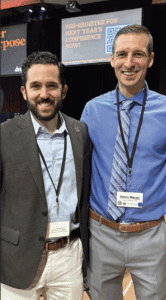
Alex Soucy is cofounder and executive director of Crossroads 4 Christ, a young adult ministry in Connecticut. He had a solid Catholic community of peers during his college years at Quinnipiac University. When he moved back home to rural Connecticut, he wanted that kind of community but found “a major void.”
“A lot of young adults are looking for friends who are pursuing the Lord,” says Soucy. “They’re looking for others who are trying to grow in holiness and would accompany them on their journey of faith.”
When Pope Francis addressed a joint session of Congress in Washington, D.C., in 2015, Soucy and his friend Travis Moran were sitting outside on the lawn of the Capitol. When Pope Francis celebrated Mass in Philadelphia, they were there, too. On the bus ride back to Connecticut, says Soucy, “we received a grace, a desire to start gathering young adults.”
They invited people to meet and pray together, and Crossroads 4 Christ was born.
Today, there are nine chapters in Connecticut of young adults meeting weekly for eucharistic adoration, teaching, and spiritual conversations.
“We want them to encounter Jesus in the Eucharist every week, to spend time with him and really get to know him,” says Soucy. “We also want them to encounter Our Lord in one another as members of the Body of Christ, and as human beings made in the image and likeness of God.”
Prayer life, Christ-centered friendships, and missionary discipleship are the fruits they hope to foster.
Angelica Bakhos MA ’23 is director of Evangelization at Crossroads 4 Christ. She earned a master of arts in catechetics and evangelization from Franciscan University. Bakhos suggested that Crossroads bring a group to the Power and Purpose Conference at Franciscan in 2025.
“She raves about the Franciscan conferences,” says Soucy, “and I’d heard so many great things about them from other people, so we decided to go.”
Soucy says it was a life-changing experience.
“It had really powerful prayer experiences, praise and worship experiences, powerful encounters with the Lord. It was deeply impactful, witnessing some of our members being slain in the Spirit, speaking in tongues, praying with such faith and courage and conviction. They were very, very fired up and dedicated in a new way to embracing the Lord and embracing evangelization.”
Soucy doesn’t come from a charismatic Catholic background, “but I recognized how there’s power in a conference like that, and there’s such power in leaning into charismatic prayer. I’m really grateful we went.”
He’s planning to bring a group to the conference this summer.
Crossroads 4 Christ is currently only in Connecticut, but Soucy says they might expand into neighboring states.
“It is really inspiring to see what the Lord is doing,” he says. “I think we’re living in a time of revival. And I think the Lord is just getting started. There are some exciting things ahead, so we’ll see what he has in store.”
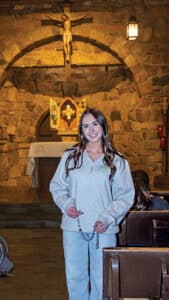 “Jesus, I Trust in You”
“Void” is a consistent theme in these stories—the empty space in the heart that the world tries to fill but can’t. Many young adults are discovering that the void is shaped like Christ, and only he fits it and fills it perfectly.
Elaina Porreca is a senior at Franciscan University. She grew up nominally Catholic but didn’t attend Mass.
“Still,” says Porreca, “deep down, I always felt a longing for Jesus. There was always something in me that missed being close to him, even if I couldn’t fully put it into words at the time.”
By high school, she knew she wanted to be in the Church. The public high school she attended had very few Catholics, so she didn’t have anyone to talk to about it.
“It was really hard to navigate my faith on my own,” says Porreca. “I remember sometimes sitting quietly in prayer, asking God to lead me home, even though I didn’t know what that would look like.”
Franciscan was her top choice for college. She wanted to be where she could grow spiritually and have the community she had been longing for.
“I didn’t know if attending Franciscan would even be possible because of the cost,” she says. “Then, I got a notification that I had received the St. Pope John Paul II Scholarship.”
It made Franciscan a possibility.
“I really felt like it was God opening the door for me, saying, ‘Come back to me.’”
Porreca didn’t hesitate to cross that threshold.
Her major is accounting, but she spent her first two years trying to catch up on everything she had missed while away from the Church.
“It felt incredible to be surrounded by like-minded people who wanted to live out their faith with joy and authenticity.”
She joined a faith household, made friends, and met a young man “who encourages me to grow closer to Christ every day.”
Porreca says one of the biggest blessings of her time at Franciscan has been rediscovering God’s mercy.
“I’ve always been deeply drawn to the message of Divine Mercy,” she says. “No matter what we’ve done or how far we’ve drifted, Jesus is always ready to forgive and embrace us. The image of Christ with rays of red and white light pouring from his heart has always touched me so deeply. It reminds me that his mercy is endless and that he desires every soul to come to him without fear or shame.”
Porreca was confirmed during her junior year at Franciscan, at the Easter Vigil, and chose St. Faustina as her confirmation name. She says the Polish saint has played an important role in her journey, modeling trust in Jesus even in times of suffering and doubt. The prayer she taught the world, “Jesus, I trust in you,” has become Porreca’s anchor.
“Through her intercession, I’ve experienced peace, healing, and the ability to forgive myself and others. She’s helped guide me closer to Christ and to a deeper understanding of his mercy. God’s mercy is always at work, even when we can’t see it right away.”
For Porreca, Franciscan has been a place of conversion, healing, and renewal.
“My life is truly changed,” she says, “and I’ll never be able to thank God enough for everything he’s given me through this community and through his infinite mercy.”
Calling Young People Deeper
Can this movement to Christ and the Catholic Church be sustained and even increased? Maybe catch fire in other generations?
The Pew survey states that people raised in religious households have a better chance of staying religious, even though that number is declining. But if every generation is a little less religious than the one before, then to halt and reverse the decline, today’s young adults would need to become more religious as they age. Or the world would need a generation of adults more religious than their parents. (Why not both?) But there are obstacles. Christianity’s decline is slowed, for now, because of the Zoomers. But the number of Zoomers who call themselves Christian is still very low, and the generations are still trending away from religion in general and Christianity in particular.
“Obviously, you’re totally reliant on the grace of the Holy Spirit in the sacraments,” says Assaf.
Having young adult events and finding ways to connect the regulars with new people is also important. Assaf encourages the members of his team to make new connections every time.
“If God is calling young people to go deeper, I also encourage spiritual direction,” he says. During spiritual highs and lows, consolation and desolation, “a guide can help push you through.”
Pometto also says reliance on the sacraments is what sustains faith, along with daily prayer and faith-filled friendships and community.
“We are not meant to walk this journey alone!” she says. “We all need to find faith-filled friends willing to journey with us on the way to heaven.”
Judging by what Gen Z and Catholicism bring to the table, they should do well together. Gen Z questions; the Church answers. Gen Z flees chaos, lies, emptiness; Christ brings order, meaning, fullness. They crave authenticity; Jesus is the Truth.
Elaina Porreca is a good example. She has the standard Gen Z laments of loneliness, the desire for meaning, the desire for something real; and then she points to Jesus: “I believe many young people have grown up in a world that tells them they can create their own truth and that success or self-expression is the highest good. But that message often leads to anxiety, loneliness, and exhaustion because it leaves out God.”
It doesn’t satisfy, she says, and it doesn’t bring happiness.
“I think that’s when they start looking for something real, something that actually gives life meaning. And that’s where people start finding Jesus again!
“I also believe people are tired of not knowing what to believe,” she continues. “The world keeps changing what it says is right or wrong, but with Christ, there is a truth that doesn’t change. I find peace within that, and I believe other people do, too.”