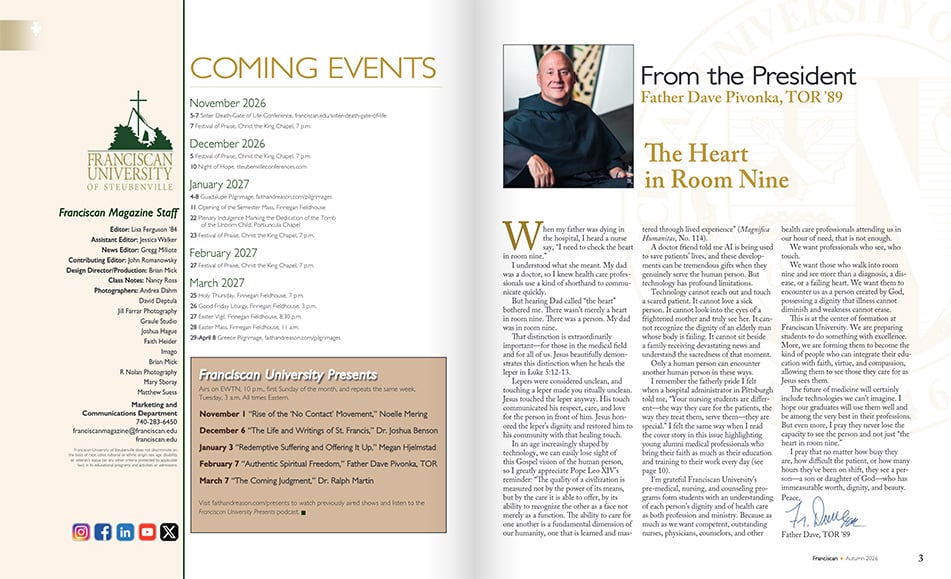

When my father was dying in the hospital, I heard a nurse say, “I need to check the heart in room nine.”
I understood what she meant. My dad was a doctor, so I knew health care professionals use a kind of shorthand to communicate quickly.
But hearing Dad called “the heart” bothered me. There wasn’t merely a heart in room nine. There was a person. My dad was in room nine.
That distinction is extraordinarily important—for those in the medical field and for all of us. Jesus beautifully demonstrates this distinction when he heals the leper in Luke 5:12-13.
Lepers were considered unclean, and touching a leper made you ritually unclean. Jesus touched the leper anyway. His touch communicated his respect, care, and love for the person in front of him. Jesus honored the leper’s dignity and restored him to his community with that healing touch.
In an age increasingly shaped by technology, we can easily lose sight of this Gospel vision of the human person, so I greatly appreciate Pope Leo XIV’s reminder: “The quality of a civilization is measured not by the power of its means, but by the care it is able to offer, by its ability to recognize the other as a face not merely as a function. The ability to care for one another is a fundamental dimension of our humanity, one that is learned and mastered through lived experience” (Magnifica Humanitas, No. 114).
A doctor friend told me AI is being used to save patients’ lives, and these developments can be tremendous gifts when they genuinely serve the human person. But technology has profound limitations.
Technology cannot reach out and touch a scared patient. It cannot love a sick person. It cannot look into the eyes of a frightened mother and truly see her. It cannot recognize the dignity of an elderly man whose body is failing. It cannot sit beside a family receiving devastating news and understand the sacredness of that moment.
Only a human person can encounter another human person in these ways.
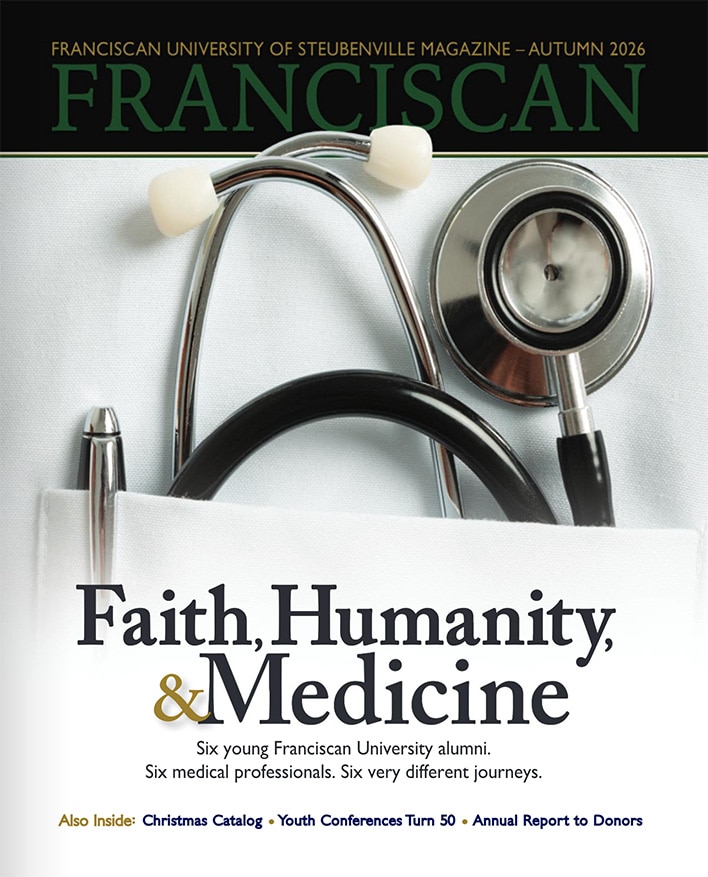
I remember the fatherly pride I felt when a hospital administrator in Pittsburgh told me, “Your nursing students are different—the way they care for the patients, the way they treat them, serve them—they are special.” I felt the same way when I read the cover story in this issue highlighting young alumni medical professionals who bring their faith as much as their education and training to their work every day (see in the article, “Faith, Humanity, & Medicine”.)
I’m grateful Franciscan University’s pre-medical, nursing, and counseling programs form students with an understanding of each person’s dignity and of health care as both profession and ministry. Because as much as we want competent, outstanding nurses, physicians, counselors, and other health care professionals attending us in our hour of need, that is not enough.
We want professionals who see, who touch.
We want those who walk into room nine and see more than a diagnosis, a disease, or a failing heart. We want them to encounter us as a person created by God, possessing a dignity that illness cannot diminish and weakness cannot erase.
This is at the center of formation at Franciscan University. We are preparing students to do something with excellence. More, we are forming them to become the kind of people who can integrate their education with faith, virtue, and compassion, allowing them to see those they care for as Jesus sees them.
The future of medicine will certainly include technologies we can’t imagine. I hope our graduates will use them well and be among the very best in their professions. But even more, I pray they never lose the capacity to see the person and not just “the heart in room nine.”
I pray that no matter how busy they are, how difficult the patient, or how many hours they’ve been on shift, they see a person—a son or daughter of God—who has immeasurable worth, dignity, and beauty.
Peace,
Father Dave, TOR ’89