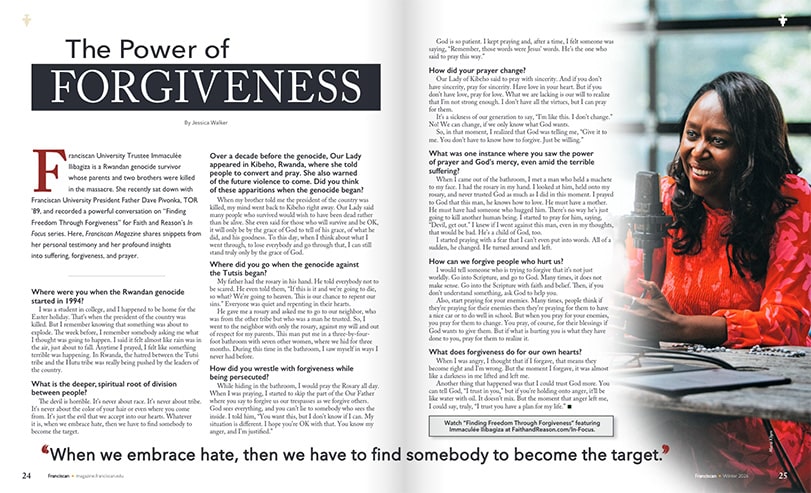


Franciscan University Trustee Immaculée Ilibagiza is a Rwandan genocide survivor whose parents and two brothers were killed in the massacre. She recently sat down with Franciscan University President Father Dave Pivonka, TOR ’89, and recorded a powerful conversation on “Finding Freedom Through Forgiveness” for Faith and Reason’s In Focus series. Here, Franciscan Magazine shares snippets from her personal testimony and her profound insights into suffering, forgiveness, and prayer.
Where were you when the Rwandan genocide started in 1994?
I was a student in college, and I happened to be home for the Easter holiday. That’s when the president of the country was killed. But I remember knowing that something was about to explode. The week before, I remember somebody asking me what I thought was going to happen. I said it felt almost like rain was in the air, just about to fall. Anytime I prayed, I felt like something terrible was happening. In Rwanda, the hatred between the Tutsi tribe and the Hutu tribe was really being pushed by the leaders of the country.
What is the deeper, spiritual root of division between people?
The devil is horrible. It’s never about race. It’s never about tribe. It’s never about the color of your hair or even where you come from. It’s just the evil that we accept into our hearts. Whatever it is, when we embrace hate, then we have to find somebody to become the target.
Over a decade before the genocide, Our Lady appeared in Kibeho, Rwanda, where she told people to convert and pray. She also warned of the future violence to come. Did you think of these apparitions when the genocide began?
When my brother told me the president of the country was killed, my mind went back to Kibeho right away. Our Lady said many people who survived would wish to have been dead rather than be alive. She even said for those who will survive and be OK, it will only be by the grace of God to tell of his grace, of what he did, and his goodness. To this day, when I think about what I went through, to lose everybody and go through that, I can still stand truly only by the grace of God.
Where did you go when the genocide against the Tutsis began?
My father had the rosary in his hand. He told everybody not to be scared. He even told them, “If this is it and we’re going to die, so what? We’re going to heaven. This is our chance to repent our sins.” Everyone was quiet and repenting in their hearts.
He gave me a rosary and asked me to go to our neighbor, who was from the other tribe but who was a man he trusted. So, I went to the neighbor with only the rosary, against my will and out of respect for my parents. This man put me in a three-by-fourfoot bathroom with seven other women, where we hid for three months. During this time in the bathroom, I saw myself in ways I never had before.
How did you wrestle with forgiveness while being persecuted?
While hiding in the bathroom, I would pray the Rosary all day. When I was praying, I started to skip the part of the Our Father where you say to forgive us our trespasses as we forgive others. God sees everything, and you can’t lie to somebody who sees the inside. I told him, “You want this, but I don’t know if I can. My situation is different. I hope you’re OK with that. You know my anger, and I’m justified.”
God is so patient. I kept praying and, after a time, I felt someone was saying, “Remember, those words were Jesus’ words. He’s the one who said to pray this way.”
How did your prayer change?
Our Lady of Kibeho said to pray with sincerity. And if you don’t have sincerity, pray for sincerity. Have love in your heart. But if you don’t have love, pray for love. What we are lacking is our will to realize that I’m not strong enough. I don’t have all the virtues, but I can pray for them.
It’s a sickness of our generation to say, “I’m like this. I don’t change.” No! We can change, if we only know what God wants. So, in that moment, I realized that God was telling me, “Give it to me. You don’t have to know how to forgive. Just be willing.”
What was one instance where you saw the power of prayer and God’s mercy, even amid the terrible suffering?
When I came out of the bathroom, I met a man who held a machete to my face. I had the rosary in my hand. I looked at him, held onto my rosary, and never trusted God as much as I did in this moment. I prayed to God that this man, he knows how to love. He must have a mother. He must have had someone who hugged him. There’s no way he’s just going to kill another human being. I started to pray for him, saying, “Devil, get out.” I knew if I went against this man, even in my thoughts, that would be bad. He’s a child of God, too.
I started praying with a fear that I can’t even put into words. All of a sudden, he changed. He turned around and left.
How can we forgive people who hurt us?
I would tell someone who is trying to forgive that it’s not just worldly. Go into Scripture, and go to God. Many times, it does not make sense. Go into the Scripture with faith and belief. Then, if you don’t understand something, ask God to help you.
Also, start praying for your enemies. Many times, people think if they’re praying for their enemies then they’re praying for them to have a nice car or to do well in school. But when you pray for your enemies, you pray for them to change. You pray, of course, for their blessings if God wants to give them. But if what is hurting you is what they have done to you, pray for them to realize it.
What does forgiveness do for our own hearts?
When I was angry, I thought that if I forgave, that means they become right and I’m wrong. But the moment I forgave, it was almost like a darkness in me lifted and left me. Another thing that happened was that I could trust God more. You can tell God, “I trust in you,” but if you’re holding onto anger, it’ll be like water with oil. It doesn’t mix. But the moment that anger left me, I could say, truly, “I trust you have a plan for my life.”
Come on a Franciscan University pilgrimage to Rwanda with Immaculée on August 31–September 11, 2026! Learn more here.