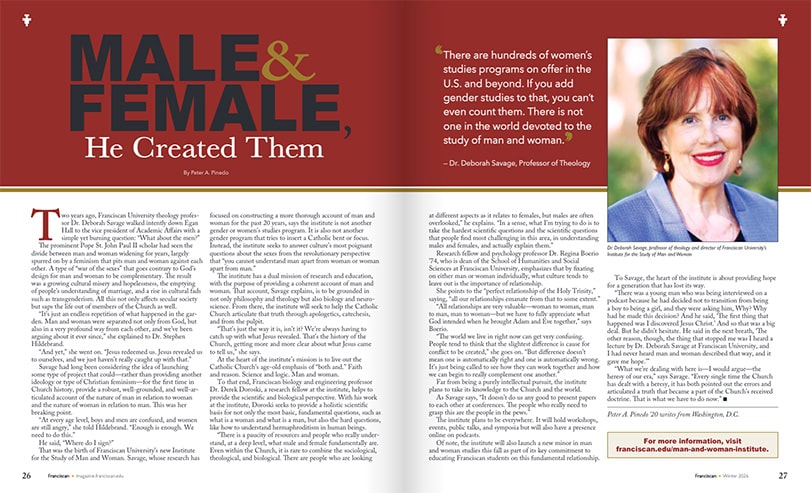

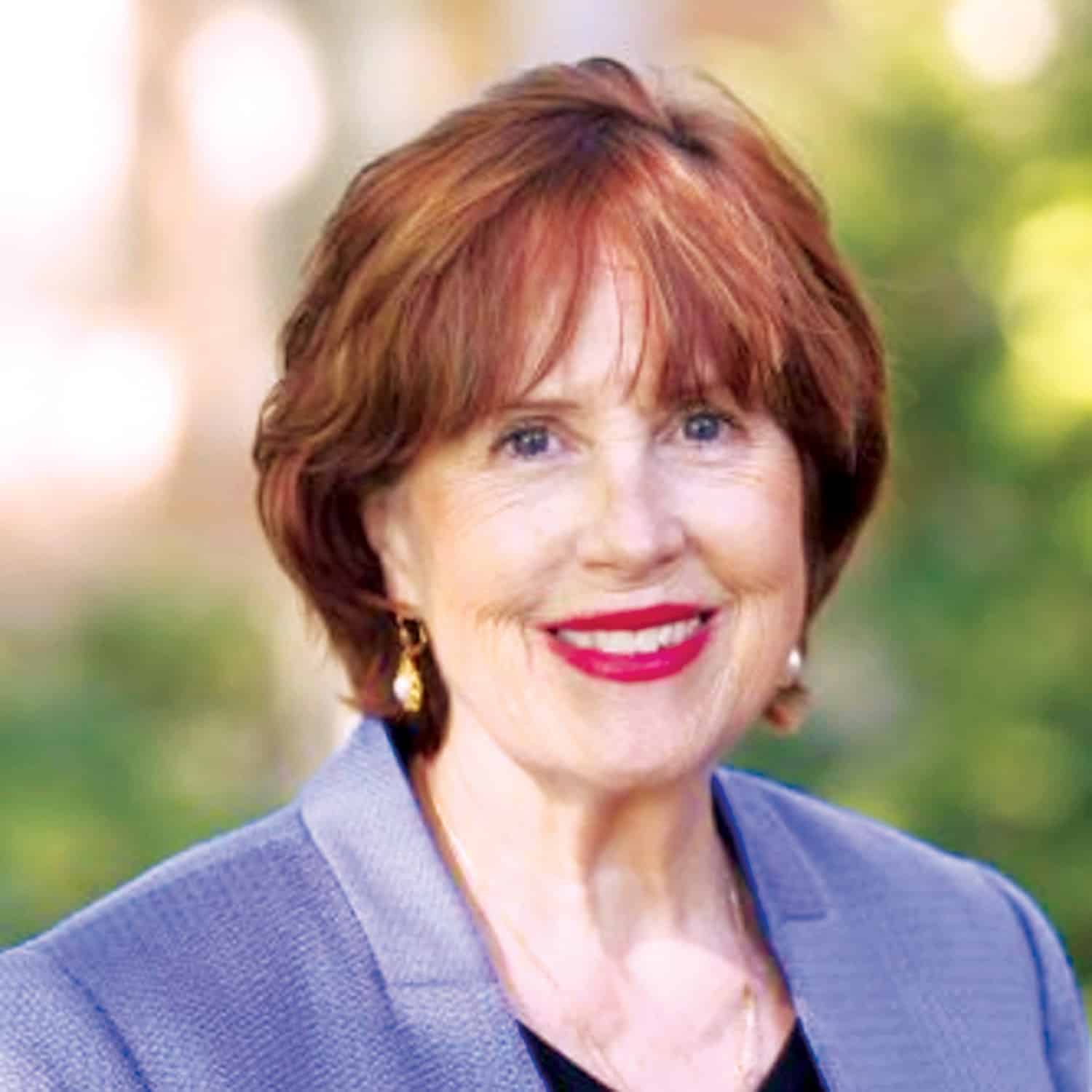
Two years ago, Franciscan University theology professor Dr. Deborah Savage walked intently down Egan Hall to the vice president of Academic Affairs with a simple yet burning question: “What about the men?”
The prominent Pope St. John Paul II scholar had seen the divide between man and woman widening for years, largely spurred on by a feminism that pits man and woman against each other. A type of “war of the sexes” that goes contrary to God’s design for man and woman to be complementary. The result was a growing cultural misery and hopelessness, the emptying of people’s understanding of marriage, and a rise in cultural fads such as transgenderism. All this not only affects secular society but saps the life out of members of the Church as well.
“It’s just an endless repetition of what happened in the garden. Man and woman were separated not only from God, but also in a very profound way from each other, and we’ve been arguing about it ever since,” she explained to Dr. Stephen Hildebrand.
“And yet,” she went on. “Jesus redeemed us. Jesus revealed us to ourselves, and we just haven’t really caught up with that.”
Savage had long been considering the idea of launching some type of project that could—rather than providing another ideology or type of Christian feminism—for the first time in Church history, provide a robust, well-grounded, and well-articulated account of the nature of man in relation to woman and the nature of woman in relation to man. This was her breaking point.
“At every age level, boys and men are confused, and women are still angry,” she told Hildebrand. “Enough is enough. We need to do this.”
He said, “Where do I sign?”
That was the birth of Franciscan University’s new Institute for the Study of Man and Woman. Savage, whose research has focused on constructing a more thorough account of man and woman for the past 20 years, says the institute is not another gender or women’s studies program. It is also not another gender program that tries to insert a Catholic bent or focus. Instead, the institute seeks to answer culture’s most poignant questions about the sexes from the revolutionary perspective that “you cannot understand man apart from woman or woman apart from man.”
The institute has a dual mission of research and education, with the purpose of providing a coherent account of man and woman. That account, Savage explains, is to be grounded in not only philosophy and theology but also biology and neuroscience. From there, the institute will seek to help the Catholic Church articulate that truth through apologetics, catechesis, and from the pulpit.
“That’s just the way it is, isn’t it? We’re always having to catch up with what Jesus revealed. That’s the history of the Church, getting more and more clear about what Jesus came to tell us,” she says.
At the heart of the institute’s mission is to live out the Catholic Church’s age-old emphasis of “both and.” Faith and reason. Science and logic. Man and woman.
To that end, Franciscan biology and engineering professor Dr. Derek Doroski, a research fellow at the institute, helps to provide the scientific and biological perspective. With his work at the institute, Doroski seeks to provide a holistic scientific basis for not only the most basic, fundamental questions, such as what is a woman and what is a man, but also the hard questions, like how to understand hermaphroditism in human beings.
“There is a paucity of resources and people who really understand, at a deep level, what male and female fundamentally are. Even within the Church, it is rare to combine the sociological, theological, and biological. There are people who are looking at different aspects as it relates to females, but males are often overlooked,” he explains. “In a sense, what I’m trying to do is to take the hardest scientific questions and the scientific questions that people find most challenging in this area, in understanding males and females, and actually explain them.”
Research fellow and psychology professor Dr. Regina Boerio ’74, who is dean of the School of Humanities and Social Sciences at Franciscan University, emphasizes that by fixating on either man or woman individually, what culture tends to leave out is the importance of relationship.
She points to the “perfect relationship of the Holy Trinity,” saying, “all our relationships emanate from that to some extent.”
“All relationships are very valuable—woman to woman, man to man, man to woman—but we have to fully appreciate what God intended when he brought Adam and Eve together,” says Boerio.
“The world we live in right now can get very confusing. People tend to think that the slightest difference is cause for conflict to be created,” she goes on. “But difference doesn’t mean one is automatically right and one is automatically wrong. It’s just being called to see how they can work together and how we can begin to really complement one another.”
Far from being a purely intellectual pursuit, the institute plans to take its knowledge to the Church and the world.
As Savage says, “It doesn’t do us any good to present papers to each other at conferences. The people who really need to grasp this are the people in the pews.”
The institute plans to be everywhere. It will hold workshops, events, public talks, and symposia but will also have a presence online on podcasts.
Of note, the institute will also launch a new minor in man and woman studies this fall as part of its key commitment to educating Franciscan students on this fundamental relationship.
To Savage, the heart of the institute is about providing hope for a generation that has lost its way.
“There was a young man who was being interviewed on a podcast because he had decided not to transition from being a boy to being a girl, and they were asking him, Why? Why had he made this decision? And he said, ‘The first thing that happened was I discovered Jesus Christ.’ And so that was a big deal. But he didn’t hesitate. He said in the next breath, ‘The other reason, though, the thing that stopped me was I heard a lecture by Dr. Deborah Savage at Franciscan University, and I had never heard man and woman described that way, and it gave me hope.’”
“What we’re dealing with here is—I would argue—the heresy of our era,” says Savage. “Every single time the Church has dealt with a heresy, it has both pointed out the errors and articulated a truth that became a part of the Church’s received doctrine. That is what we have to do now.”