
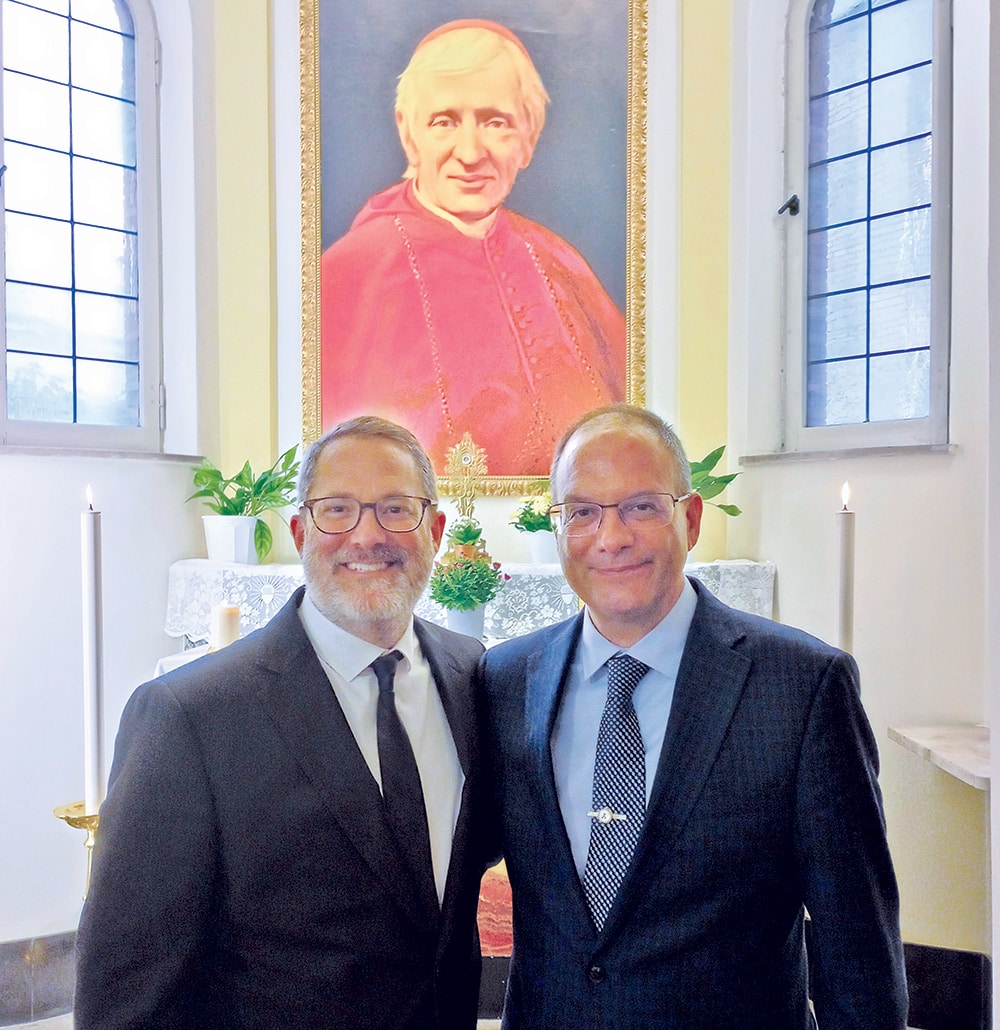
Pope Leo XIV declared St. John Henry Newman a Doctor of the Universal Church on November 1. Franciscan University philosophy professor Dr. Logan Gage was among a select group of scholars seated in the front row at the Mass in St. Peter’s Basilica. The place of honor signaled the Church’s gratitude for his behind-the-scenes role in preparing the case for Newman’s elevation. Gage contributed to the Positio, the official Vatican document presented to the Dicastery for the Causes of Saints. Gage spoke with Franciscan Magazine about his role.
How did you first get interested in Newman?
Over a decade ago, I received funding from the Lumen Christi Institute at the University of Chicago to study with Father Ian Ker in Oxford. Father Ker was a leading Newman scholar. I took this opportunity to read a lot of Newman and ask questions in Father Ker’s seminars.
How did you get involved in the Positio process?
Dr. Frederick Aquino, a professor of theology at Southern Methodist University, and I were asked to contribute to the Positio by the National Institute for Newman Studies. We have written numerous articles on Newman together over the last decade. We wrote the chapter on Newman and his view of faith and reason.
What importance does Newman have today?
Newman is probably most known for his understanding of the development of doctrine, the importance of conscience as a path to God, and his vision of a Catholic and liberal arts education. But I think it is his epistemology that deserves to be better known. He has a very helpful understanding of how it is that human beings arrive at certitude.
In his book A Grammar of Assent, he describes this process and how we come to be certain that, for instance, one day we will die or that Great Britain is an island. He then tries to show how it is we can arrive at a kind of certitude about religious matters in the same way (even if divine aid is necessary for full divine faith).
St. Newman maintains that we typically gain certainty not with one killer argument but with a great host of reasons. It is precisely because of all the evidence and reasons we have for Great Britain being an island that we are so certain of this fact. Every book we’ve read, every news report, every conversation has confirmed this fact. Yet, it is not capable of strict demonstration or proof.
Similarly, for many of us, belief in God might be so certain because of the very broad base of evidence we have for this truth. He tells us that the way we become so certain is “the culmination of probabilities, independent of each other, arising out of the nature and circumstances of the particular case which is under review; probabilities too fine to avail separately, too subtle and circuitous to be convertible into syllogisms, too numerous and various for such conversion, even were they convertible.”
In fact, Newman argues that we possess a faculty he calls “the illative sense.” It is by this mental faculty that we can so easily form convictions based on numerous and disparate lines of probabilistic evidence. Endowed with this power, we can see the overwhelming direction of the evidence and believe in its direction with conviction.
How can we develop a better relationship with Newman?
You might start by picking up Newman’s works such as The Idea of a University (if you are interested in education) or An Essay on the Development of Christian Doctrine (if you are interested in theology). The former work has inspired many of us with its vision of the liberal arts and the formation of intellectual virtue in our students. The latter work, dear to many of us converts, explores the way that the understanding of Christian doctrine can grow in an organic and authentic way from the seeds given to the Apostles; genuine doctrinal development contains certain hallmarks, he argues.
Lastly, for an introduction to many of Newman’s most significant ideas, you might read our own Dr. John Crosby’s book, The Personalism of John Henry Newman. Dr. Crosby is a true expert on all things Newman.